%3Aformat(webp)%2Fimg%2F2048x1536%2F302839.jpg&w=1920&q=75)
Two things make Japan different: you take your shoes off a great deal, and your suitcase travels separately.
Get those right and the rest is ordinary sensible packing.
In short
You will remove your shoes at temples, at traditional accommodation, in some restaurants, and at your host family's home in the countryside.
Slip-ons, or shoes with laces you do not need to retie. Anything you have to sit down to remove becomes tiresome by the third day.
Socks without holes, said with complete seriousness — they are on display more than you are used to.
And shoes you can walk a long way in. Japan involves a great deal of walking on hard surfaces: stations, city pavements, temple grounds, and the Fushimi Inari shrine's thousands of torii gates. Our page on how much walking there is on a Japan tour sets out the distances honestly.
One pair of comfortable walking shoes and one lighter pair is enough for a fortnight.
%3Aformat(webp)%2Fheader_media%2Fbf350ea2-ea58-470f-a146-997785e3a26e-pexels-dsd-143941-1822605.jpg&w=1920&q=75)
Spring (our March–May). The cherry blossom season and one of the two peaks. Cool mornings, mild afternoons, and genuinely changeable — layers and a light waterproof. See cherry blossom timing and crowds.
Autumn (September–November). The other peak, and for many travellers the better one: comfortable temperatures, low rainfall and the foliage. Same advice — layers, and something warmer for the evenings later in the season. See Japan's autumn colours.
Summer. Hot and humid, and wet in June and July. Light, breathable clothing, and accept that you will change more often.
Winter. Cold, particularly in the mountains, and quieter for it.
Our departures cluster in spring and autumn, which is when the country is at its best — so layers are the answer for most travellers.
%3Aformat(webp)%2Fday_detail%2F40883ef3-9a75-4a2a-b9ca-d7170f1c0875-whatsapp-image-2025-07-16-at-08.30.39.jpeg&w=1920&q=75)
This is the Japan-specific thing to plan for, and it is a pleasure once you understand it.
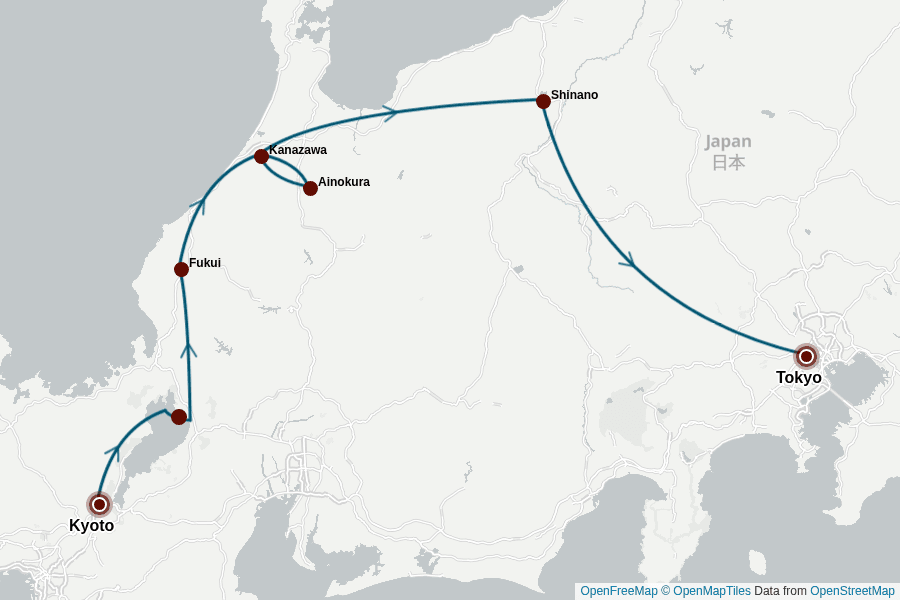
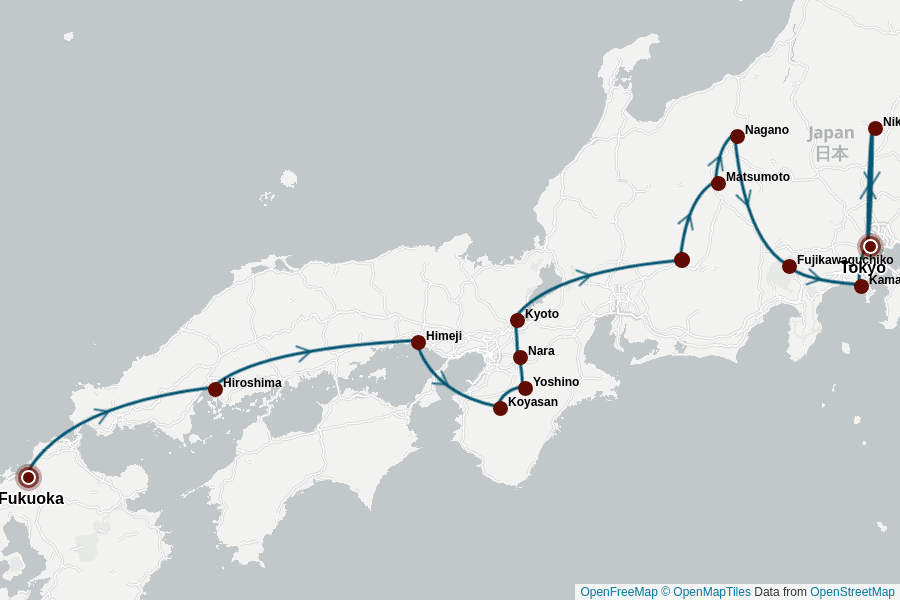
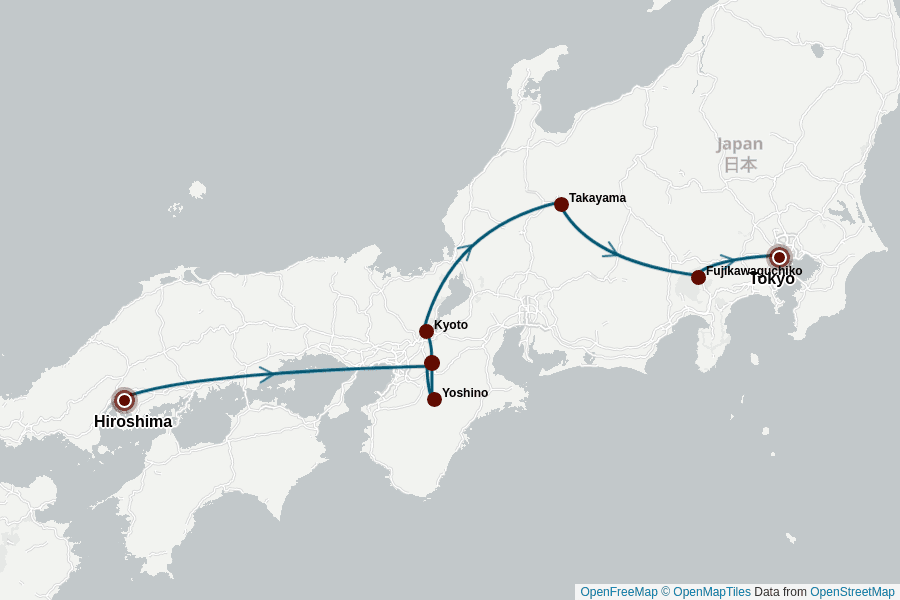
At set points your main bag is sent ahead by courier to the next hotel while you travel with a day bag. On the fourteen-day route that happens from Hiroshima to Kyoto and again from Kyoto to Tokyo; on the twenty-day route it happens repeatedly, and on the Nakasendo walk even your daypack is sent ahead.
So pack an overnight kit that stays with you: a change of clothes, nightwear, toothbrush and toiletries, medication, chargers, documents. Assume you will not see the main bag until the next evening.
A soft daypack is the single most useful item — better than a shoulder bag on trains and stairs.
Luggage forwarding in Japan explains which days and why.
%3Aformat(webp)%2Fhighlight%2F49d9c881-a2db-427e-956e-08bab525aae3-14809814300_bec2645434_o.jpg&w=1920&q=75)
A hand towel. Many public washrooms have no dryer and no paper. Japanese people carry one; you should too.
Cash. Japan is more card-friendly than it was and still less than Britain, particularly at small restaurants and shrines.
A small bag for rubbish. Public bins are genuinely rare, and you are expected to carry your litter until you find one.
Deodorant and any specific toiletries you are particular about — availability differs from home.
Larger shoe sizes are harder to buy in Japan, so bring what you need.
A plug adapter. Japan uses two flat pins.
Something to sleep in that you would not mind being seen in — traditional accommodation provides yukata, and corridors are communal.
%3Aformat(webp)%2Fhubspot_blogs%2F7494540430-270426.jpg&w=1920&q=75)
Less than you think, for three reasons.
Hotel rooms are small. A large case open on the floor of a Japanese city room takes up most of the floor.
Stations have stairs. The courier service exists precisely because Japanese rail was not designed around wheeled suitcases, and on the days your bag is with you, you are the one managing it.
Laundry is easy, and coin laundries are everywhere and straightforward.
And you will buy things. Ceramics, textiles, stationery, food. Everyone does. Leaving a third of the case empty is not optimism, it is planning.
One medium case and a daypack is the right shape for any of our routes — twelve, fourteen or twenty days. All are land-only, so your airline's limit is the binding one; check it when you book your flights.
Select Date Range
Contact us
We’d love to hear from you. Please fill out this form.
All fields marked with (*) are mandatory.
%3Aformat(webp)%2Fhubspot_blogs%2F7494540430-270426.jpg&w=1920&q=75)
%3Aformat(webp)%2Fhighlight%2F49d9c881-a2db-427e-956e-08bab525aae3-14809814300_bec2645434_o.jpg&w=1920&q=75)
%3Aformat(webp)%2Fday_detail%2F40883ef3-9a75-4a2a-b9ca-d7170f1c0875-whatsapp-image-2025-07-16-at-08.30.39.jpeg&w=1920&q=75)

%3Aformat(webp)%2Ftravel_report_photo%2F82454%2F1801fc65-2b8a-463a-81ea-f3667803ca89-F3E0C42F-01A8-4E52-B4D9-DFD809199453.jpg&w=1920&q=75)
%3Aformat(webp)%2Fprofile-picture%2F5eefd57b-6c1b-49d0-8b90-eec430dbea31-dcc716ae-0681-47a9-8dee-8302ea7cbe02-c0cbebc6-a55d-4dd3-b824-4f1b72ae39b3.jpeg&w=1920&q=75)
%3Aformat(webp)%2Fhubspot_blogs%2F70794303268-3Apr11202210105536AM.png&w=1920&q=75)
%3Aformat(webp)%2Fimg%2F2048x1536%2F269723.jpg&w=1920&q=75)
%3Aformat(webp)%2Fprofile-picture%2F931d06cf-3d6a-42aa-956a-1ecce7079159-5fd74991-6c73-4f43-8298-6fda2d261d1d-7FA23F9B-A826-427F-8A4E-C1E2D3A01559.jpg&w=1920&q=75)
%3Aformat(webp)%2F6682e168-e97c-4a89-a861-88229f57d072-kanazawa-castle.jpg&w=1920&q=75)
%3Aformat(webp)%2Ftravel_report_photo%2F84516%2Fc540e5c8-bb92-40bc-8710-5554864e95b2-7AE4A5AA-176C-42E4-880D-83AA3A75EFCC.jpg&w=1920&q=75)
%3Aformat(webp)%2F94126af0-449f-4709-b69c-64f044c3f720-img_3021.jpg&w=1920&q=75)
%3Aformat(webp)%2Ftravel_report_photo%2F84408%2F43c5610c-0aeb-4714-ad75-e20153e92eb7-5C9B2829-6907-46DF-ACF2-B0403BD7A419.jpg&w=1920&q=75)
%3Aformat(webp)%2Fday_detail%2F4b2374e2-99e1-481c-9084-278276ff1302-antoine-cantoro-6y0u0wodxnw-unsplash.jpg&w=1920&q=75)
%3Aformat(webp)%2Ftravel_report_photo%2F83531%2F3b22254e-f14e-4b9a-9429-b562f2bf64a8-2F8501E7-DC9C-484F-AFAE-DE70E56B2949.jpg&w=1920&q=75)
%3Aformat(webp)%2Ftravel_report_photo%2F84499%2F682ade66-d4b2-419d-839b-d70480a55b9d-3d236001-6e39-4431-88d0-472c11e65cef.jpeg&w=1920&q=75)
%3Aformat(webp)%2F44e78e22-2282-4f09-a975-0d1f3fca21a9-timo-volz-dgsql2j028e-unsplash.jpg&w=1920&q=75)