%3Aformat(webp)%2Fday_detail%2F40883ef3-9a75-4a2a-b9ca-d7170f1c0875-whatsapp-image-2025-07-16-at-08.30.39.jpeg&w=1920&q=75)
One of the quiet pleasures of travelling in Japan is that your suitcase does not come with you.
Japan has a courier culture with no real British equivalent. Bags are collected from a hotel reception in the morning and are waiting at the next hotel when you arrive. It is fast, it is astonishingly reliable, and it is built into our itineraries rather than offered as an extra.
In short
Because of the stairs.
Japanese rail is the best in the world at moving people and was not designed around wheeled suitcases. Stations have long corridors, frequent stair flights, and connections measured in minutes. Shinkansen carriages have limited space for large cases, and oversized bags now need a reserved space.
Then there is the shape of a good Japanese itinerary. The best nights are often in places a suitcase does not belong: a countryside host family, a temple town, a mountain village. Dragging a large case up to a traditional house is nobody's idea of an arrival.
So the courier service is not a luxury. It is the thing that lets the itinerary go to the places worth going to.
%3Aformat(webp)%2Fimg%2F2048x1536%2F302839.jpg&w=1920&q=75)
It differs by route, and the itinerary names each one.
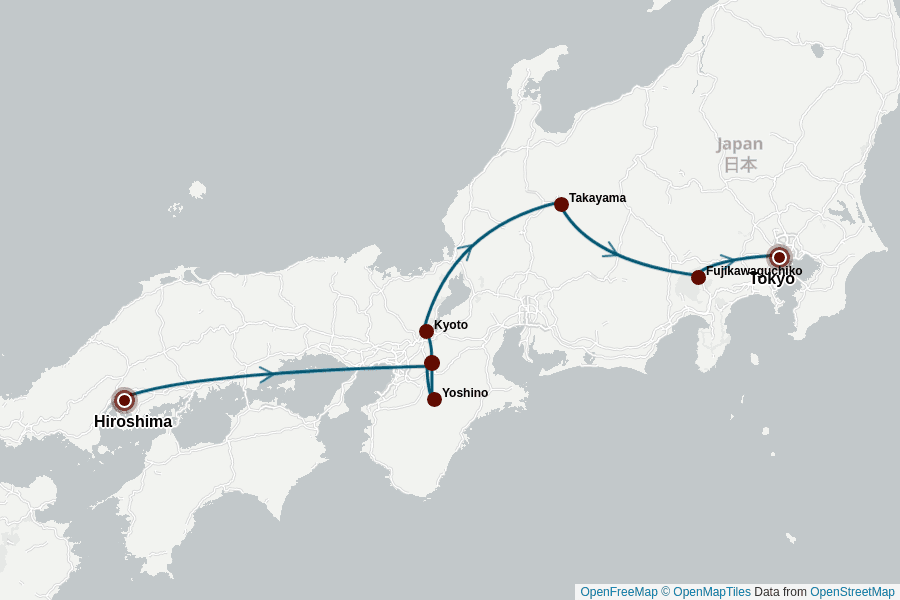
Fourteen days, Fukuoka to Tokyo. Your luggage goes ahead from Hiroshima to Kyoto, so you are unencumbered for Shigisan and the host-family night; and later from Kyoto to Tokyo, so you can enjoy Takayama and Mount Fuji with a light bag.
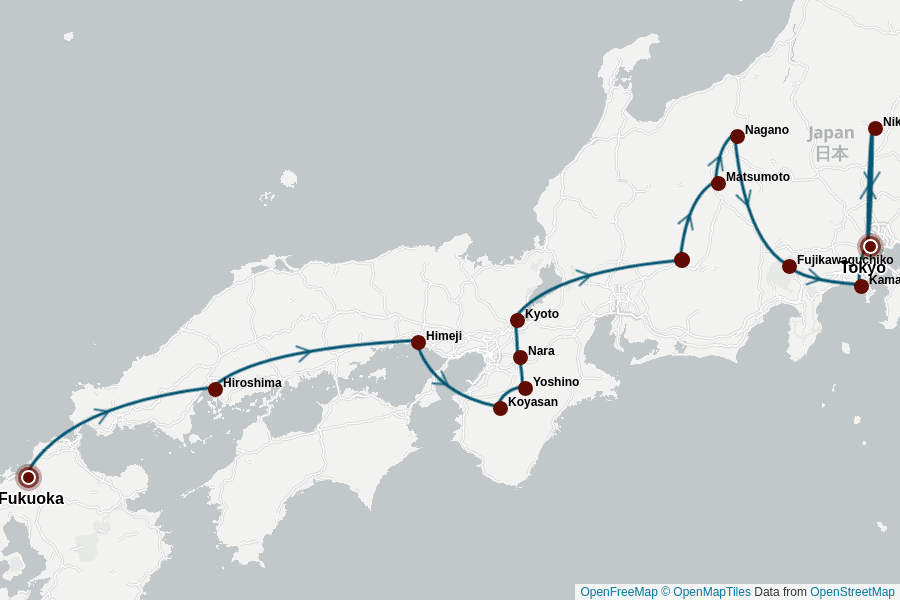
Twenty days, the Golden Route Plus. Used repeatedly, with the Taqbin service: bags go ahead from Himeji to Kyoto, again before the Nakasendo, again before Kamakura, and on to Tokyo. On the Nakasendo walk even your daypack is sent ahead from Magome to Tsumago, so you walk the old post road carrying nothing.
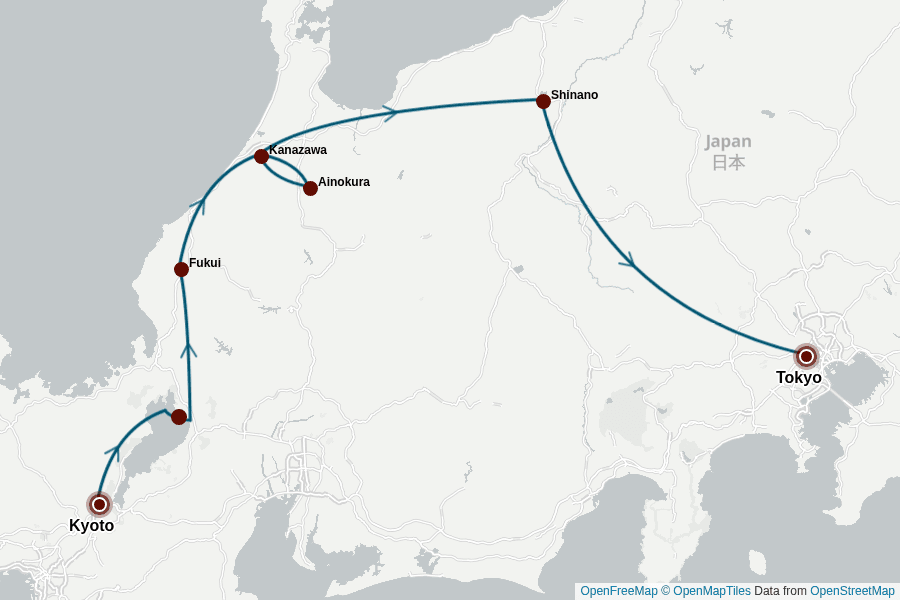
Twelve days, Kyoto to Tokyo. The route is built around fewer base changes, so there is less need for it.
Your guide handles the drop-off at reception. You do not need to speak to the courier, fill in a form, or pay.
%3Aformat(webp)%2Fhighlight%2F49d9c881-a2db-427e-956e-08bab525aae3-14809814300_bec2645434_o.jpg&w=1920&q=75)
This is the part to get right, because your case typically arrives the following day.
Keep with you: a change of clothes, nightwear, toothbrush and toiletries, any medication, chargers, documents and money. Assume you will not see your main bag until the next evening.
A soft day bag is the single most useful thing to pack. A small rucksack works better than a shoulder bag on trains and stairs.
Onsen and host-family nights: you will want something comfortable and easy to change out of. Traditional accommodation provides yukata, so you need less than you think.
Do not put valuables in the forwarded bag. The service is extremely reliable, but the ordinary rule applies: passports, money and electronics stay with you.
%3Aformat(webp)%2Fheader_media%2Fbf350ea2-ea58-470f-a146-997785e3a26e-pexels-dsd-143941-1822605.jpg&w=1920&q=75)
In our experience, yes — Japan's courier network is one of the most reliable logistics systems anywhere, and same-day or next-day delivery between hotels is routine rather than remarkable.
What we will not do is promise it can never go wrong, because no delivery system is perfect. What we can say is that a group of a maximum of 12 travellers moving with a guide means that if something did go astray, there is somebody there whose job it is to sort it out in Japanese, that day.
The practical protection is the one above: pack an overnight bag as though your case will be a day behind, and then it does not matter if it is.
%3Aformat(webp)%2Fhighlight%2F991030fe-21c6-46c3-be3e-972bffbdd41e-red-chilli-cooking-class-chiang-mai.jpg&w=1920&q=75)
Luggage forwarding is a small thing that says something larger about how these itineraries are put together: the friction is designed out so that the days are spent on Japan rather than on logistics.
The same thinking sits behind the walking distances, the choice of Fukuoka rather than Tokyo as a starting point on the fourteen-day route, and the decision to base four nights in Kyoto rather than move every day.
If the physical side is your main question, how much walking is there on a Japan tour is the honest answer, including the days with stairs and the ones with none.
All our Japan trips are land-only, take a maximum of 12 travellers, and run on guaranteed departures.
Select Date Range
Contact us
We’d love to hear from you. Please fill out this form.
All fields marked with (*) are mandatory.
%3Aformat(webp)%2Fhubspot_blogs%2F7494540430-270426.jpg&w=1920&q=75)
%3Aformat(webp)%2Fhighlight%2F49d9c881-a2db-427e-956e-08bab525aae3-14809814300_bec2645434_o.jpg&w=1920&q=75)
%3Aformat(webp)%2Fheader_media%2Fbf350ea2-ea58-470f-a146-997785e3a26e-pexels-dsd-143941-1822605.jpg&w=1920&q=75)

%3Aformat(webp)%2Ftravel_report_photo%2F82454%2F1801fc65-2b8a-463a-81ea-f3667803ca89-F3E0C42F-01A8-4E52-B4D9-DFD809199453.jpg&w=1920&q=75)
%3Aformat(webp)%2Fprofile-picture%2F5eefd57b-6c1b-49d0-8b90-eec430dbea31-dcc716ae-0681-47a9-8dee-8302ea7cbe02-c0cbebc6-a55d-4dd3-b824-4f1b72ae39b3.jpeg&w=1920&q=75)
%3Aformat(webp)%2Fhubspot_blogs%2F70794303268-3Apr11202210105536AM.png&w=1920&q=75)
%3Aformat(webp)%2Fimg%2F2048x1536%2F269723.jpg&w=1920&q=75)
%3Aformat(webp)%2Fprofile-picture%2F931d06cf-3d6a-42aa-956a-1ecce7079159-5fd74991-6c73-4f43-8298-6fda2d261d1d-7FA23F9B-A826-427F-8A4E-C1E2D3A01559.jpg&w=1920&q=75)
%3Aformat(webp)%2F6682e168-e97c-4a89-a861-88229f57d072-kanazawa-castle.jpg&w=1920&q=75)
%3Aformat(webp)%2Ftravel_report_photo%2F84516%2Fc540e5c8-bb92-40bc-8710-5554864e95b2-7AE4A5AA-176C-42E4-880D-83AA3A75EFCC.jpg&w=1920&q=75)
%3Aformat(webp)%2F94126af0-449f-4709-b69c-64f044c3f720-img_3021.jpg&w=1920&q=75)
%3Aformat(webp)%2Ftravel_report_photo%2F84408%2F43c5610c-0aeb-4714-ad75-e20153e92eb7-5C9B2829-6907-46DF-ACF2-B0403BD7A419.jpg&w=1920&q=75)
%3Aformat(webp)%2Fday_detail%2F4b2374e2-99e1-481c-9084-278276ff1302-antoine-cantoro-6y0u0wodxnw-unsplash.jpg&w=1920&q=75)
%3Aformat(webp)%2Ftravel_report_photo%2F83531%2F3b22254e-f14e-4b9a-9429-b562f2bf64a8-2F8501E7-DC9C-484F-AFAE-DE70E56B2949.jpg&w=1920&q=75)
%3Aformat(webp)%2Ftravel_report_photo%2F84499%2F682ade66-d4b2-419d-839b-d70480a55b9d-3d236001-6e39-4431-88d0-472c11e65cef.jpeg&w=1920&q=75)
%3Aformat(webp)%2F44e78e22-2282-4f09-a975-0d1f3fca21a9-timo-volz-dgsql2j028e-unsplash.jpg&w=1920&q=75)