%3Aformat(webp)%2Fprovider%2Ffb1a1eb5-5141-480b-9877-a791074fbd43-kimono.jpeg&w=1920&q=75)
Expect to be on your feet for much of each sightseeing day — but rarely walking far in one go. Japan is a country you see on foot and by train, not from a coach window. On a typical day you might cover a few miles in short stretches: a temple complex here, a market street there, a walk between stations, with sitting-down time in between.
What catches British travellers out is not distance. It is steps and standing. Shrines sit up flights of stone stairs, stations are multi-level, and there is a fair amount of getting on and off trains.
In short
Take a Kyoto day on our Japan Essentials tour. You might begin at the Kyoto Station Skyway, a glass walkway suspended 45 metres above the station hall, then move out to the bamboo grove at Arashiyama, and finish among the vermilion torii gates of Fushimi Inari.
None of those is a hike. Each is perhaps twenty minutes to an hour of unhurried walking, with pauses, photographs and a good deal of standing while your guide explains what you are looking at. Add the walking between train stations and you have a day of several hours on your feet — spread across the day, not endured in one push.
At Fushimi Inari the path climbs the hillside through the gate tunnels. How far up you go is genuinely your decision; the most photographed stretch is near the bottom, and turning back is completely normal.
The one properly rural walk on the Essentials route is at Lake Kawaguchi, a thirty-minute walk up to the Koyodai Observatory for the view of Mount Fuji.
%3Aformat(webp)%2Fa9ed18bb-3811-4c78-b1a5-702a25a826f5-de103_kv_ishigaki-island-scenery.webp&w=1920&q=75)
This is the part worth thinking about honestly before you book.
Temples and shrines are frequently approached up stone staircases, sometimes without a handrail, and often uneven from centuries of use. Railway stations in Japan are superbly organised but vertical — expect stairs and escalators between levels, occasionally with a short walk along a platform to make a connection. Traditional accommodation and some restaurants involve stepping up and down, and taking your shoes off, which is why we suggest shoes that slip on and off easily.
None of this is unmanageable if steps are merely tiring for you. If steps are a genuine difficulty — if you avoid stairs at home, or need a lift where one exists — please tell your specialist before booking rather than after. Japan is not an easy country in which to arrange step-free alternatives at short notice, and it is far better to know that in advance.
%3Aformat(webp)%2Fccab579d-5a3c-4f35-86e4-242d6a3a7080-takashi-miyazaki-4velvd-vdvg-unsplash.jpg&w=1920&q=75)
One of the quiet pleasures of travelling in Japan is that your suitcase can travel separately, and on our Japan Essentials tour it does — twice.
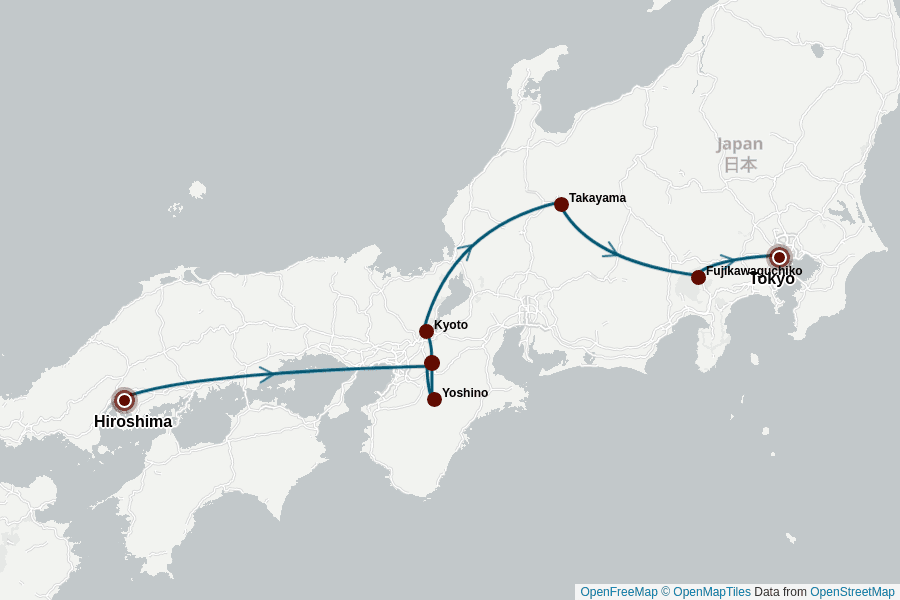
Your main bag is sent by courier from your Hiroshima hotel ahead to Kyoto, so you can enjoy the days in between unencumbered, and later from Kyoto ahead to Tokyo while you travel via Takayama and Mount Fuji. You keep a small overnight bag with you for those nights.
This is a genuinely Japanese piece of infrastructure — reliable, inexpensive and used by everyone — and it removes most of what makes multi-city travel tiring. We recommend one checked bag of up to 23 kg plus a 30–40 litre daypack for excursions. Travelling light is worth it: several hotels offer laundry, and you will want the space for what you buy.
%3Aformat(webp)%2Fhubspot_blogs%2F70794303268-3Apr11202210105536AM.png&w=1920&q=75)
Japan's cities are linked by the Shinkansen, and we use it. That changes the shape of a day considerably compared with a coach tour: journeys are short, seats are wide, you are free to move about, and you arrive in the centre of the next city rather than on its ring road.
The trade-off is honest enough — you carry your day bag on and off trains yourself, and there is walking within stations. In exchange you avoid the thing most travellers over 50 tell us they dislike most about organised touring: long days sitting on a coach.
Group sizes are small, at a maximum of 12 travellers, which means the pace within a day can be adjusted far more easily than on a large tour.
%3Aformat(webp)%2Fhubspot_blogs%2F6007207693-TokyoskylineinJapan2.jpeg&w=1920&q=75)
Japan Essentials — fourteen days from Fukuoka to Tokyo, taking in Hiroshima, Miyajima, Nara, a countryside homestay, four days in Kyoto, Takayama, Mount Fuji and Tokyo. The most balanced choice for a first visit, and the one with the two luggage transfers described above.
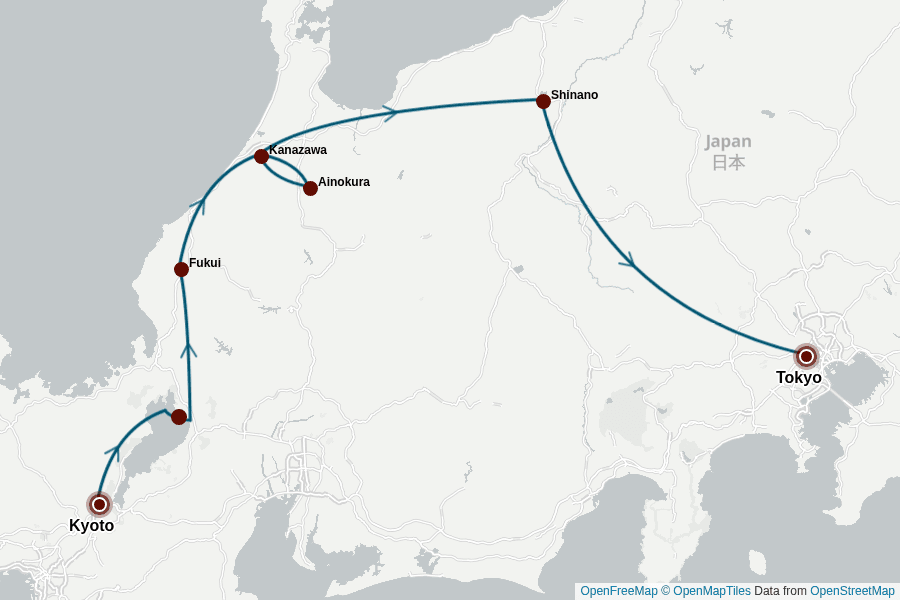
Japan Undiscovered: Kanazawa and Hidden Treasures — twelve days, starting in Kyoto rather than Fukuoka. Fewer moves, a gentler shape, and quieter places: Lake Biwa, the temples of Fukui, the Gassho-zukuri villages, the old samurai quarter of Kanazawa.
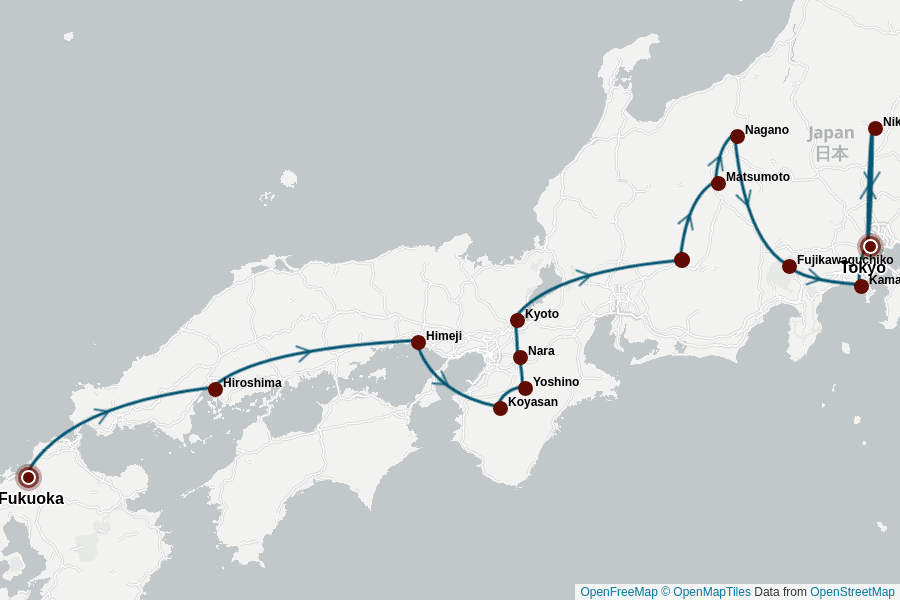
Golden Route Plus — twenty days, and correspondingly more ground: Koyasan, Himeji, the Nakasendo trail, Matsumoto, Nagano, Kamakura and Nikko alongside the classics. Choose it if you would rather go once and go properly.
All are land-only, so you book the flights that suit you, and all run on guaranteed departures. If you are uncertain about the walking, tell a Japan specialist what you can comfortably manage and they will tell you straight whether these trips fit.
Select Date Range
Contact us
We’d love to hear from you. Please fill out this form.
All fields marked with (*) are mandatory.
%3Aformat(webp)%2Fprovider%2Ffb1a1eb5-5141-480b-9877-a791074fbd43-kimono.jpeg&w=1920&q=75)
%3Aformat(webp)%2Fprovider%2Ff45dc6a1-8dfd-421b-9aab-ee99b3d68b9b-1mc6912000k5zec4v0ce8_w_1280_853_r5.webp&w=1920&q=75)

%3Aformat(webp)%2Ftravel_report_photo%2F82454%2F1801fc65-2b8a-463a-81ea-f3667803ca89-F3E0C42F-01A8-4E52-B4D9-DFD809199453.jpg&w=1920&q=75)
%3Aformat(webp)%2Fprofile-picture%2F5eefd57b-6c1b-49d0-8b90-eec430dbea31-dcc716ae-0681-47a9-8dee-8302ea7cbe02-c0cbebc6-a55d-4dd3-b824-4f1b72ae39b3.jpeg&w=1920&q=75)
%3Aformat(webp)%2Fhubspot_blogs%2F70794303268-3Apr11202210105536AM.png&w=1920&q=75)
%3Aformat(webp)%2Fimg%2F2048x1536%2F269723.jpg&w=1920&q=75)
%3Aformat(webp)%2Fprofile-picture%2F931d06cf-3d6a-42aa-956a-1ecce7079159-5fd74991-6c73-4f43-8298-6fda2d261d1d-7FA23F9B-A826-427F-8A4E-C1E2D3A01559.jpg&w=1920&q=75)
%3Aformat(webp)%2F6682e168-e97c-4a89-a861-88229f57d072-kanazawa-castle.jpg&w=1920&q=75)
%3Aformat(webp)%2Ftravel_report_photo%2F84516%2Fc540e5c8-bb92-40bc-8710-5554864e95b2-7AE4A5AA-176C-42E4-880D-83AA3A75EFCC.jpg&w=1920&q=75)
%3Aformat(webp)%2Fheader_media%2Fdd5149a2-07da-420b-a8ba-051a9f826b4a-img_5059.jpeg&w=1920&q=75)
%3Aformat(webp)%2Ftravel_report_photo%2F84408%2F43c5610c-0aeb-4714-ad75-e20153e92eb7-5C9B2829-6907-46DF-ACF2-B0403BD7A419.jpg&w=1920&q=75)
%3Aformat(webp)%2Fday_detail%2F4b2374e2-99e1-481c-9084-278276ff1302-antoine-cantoro-6y0u0wodxnw-unsplash.jpg&w=1920&q=75)
%3Aformat(webp)%2Ftravel_report_photo%2F83531%2F3b22254e-f14e-4b9a-9429-b562f2bf64a8-2F8501E7-DC9C-484F-AFAE-DE70E56B2949.jpg&w=1920&q=75)
%3Aformat(webp)%2Ftravel_report_photo%2F84499%2F682ade66-d4b2-419d-839b-d70480a55b9d-3d236001-6e39-4431-88d0-472c11e65cef.jpeg&w=1920&q=75)
%3Aformat(webp)%2F44e78e22-2282-4f09-a975-0d1f3fca21a9-timo-volz-dgsql2j028e-unsplash.jpg&w=1920&q=75)