%3Aformat(webp)%2Fhubspot_blogs%2F182710535987-JAPHanamiplaces1.png&w=1920&q=75)
The blossom is not a single week in one place — it is a wave that moves up the country over about six weeks. Understanding that is the difference between a trip built on hope and one built on odds.
The front begins in the subtropical south and works north. A traveller who books a week in Tokyo and hopes has one roll of the dice. A traveller moving south to north through the season is following the wave, which is a considerably better bet.
In short
Because it is a plant responding to weather, and weather is not bookable.
Forecasts are issued each year and are reasonably good — but they are forecasts, revised repeatedly as the season approaches, and they shift by a week or more between the first estimate and the event. A warm February pulls everything forward; a cold snap holds it back.
An individual tree is in full flower for roughly a week. Heavy rain or strong wind can take the petals down in a day, which is part of why the Japanese have a word for the beauty of the fall as well as the bloom.
We would rather tell you this plainly than sell you certainty. What we can do is stack the odds — through where the trip goes, in what order, and when.
%3Aformat(webp)%2Fa9ed18bb-3811-4c78-b1a5-702a25a826f5-de103_kv_ishigaki-island-scenery.webp&w=1920&q=75)
This is the practical trick, and it falls out of our route rather than being bolted on.
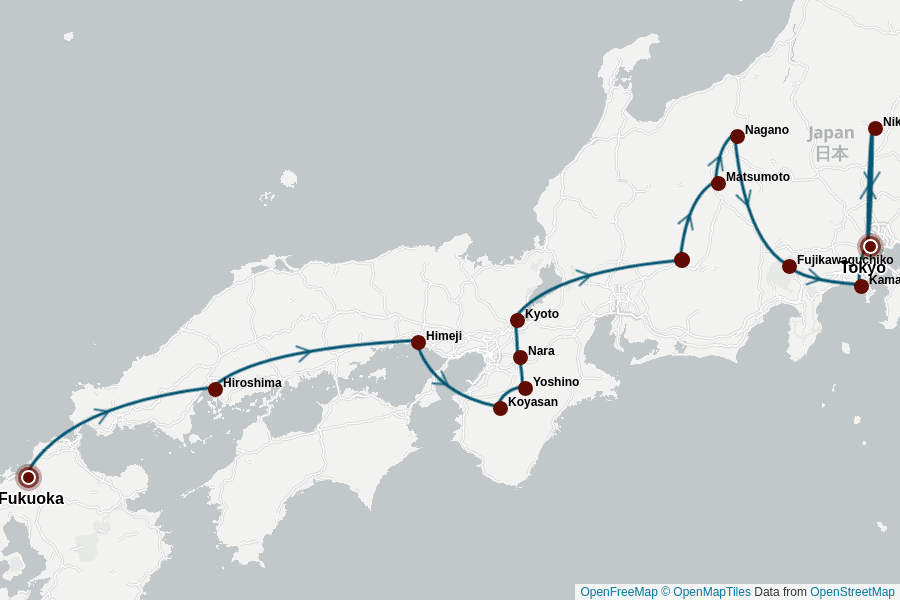
Japan Essentials starts in Fukuoka, on the southern island of Kyushu, and works north over fourteen days through Hiroshima, Nara, Kyoto and the Japanese Alps to Tokyo. That is the same direction the blossom front travels, at broadly a comparable pace.
The practical effect is that you are not betting on one city on one date. If the south is early you catch it at the start; if the season is late you meet it further north. Two weeks of movement gives the wave several chances to intersect with you.
It is not a guarantee — nothing is — but it is a much better structure than a fixed week in one place, which is what most blossom-season packages offer.
%3Aformat(webp)%2Fccab579d-5a3c-4f35-86e4-242d6a3a7080-takashi-miyazaki-4velvd-vdvg-unsplash.jpg&w=1920&q=75)
Blossom season is the busiest time in Japan, domestically as well as internationally. Being honest about that is more useful than pretending otherwise.
The famous spots are genuinely crowded. Certain Kyoto temples and Tokyo parks in early April are extremely busy, at all hours.
Ordinary places are not. Blossom is everywhere — riverbanks, station approaches, suburban streets, castle grounds in smaller cities. Some of the best hanami of any trip happens somewhere with no name on it.
Early mornings transform it. The same site at seven and at eleven are different experiences.
Smaller cities carry the season beautifully. Takayama, Nara, Kanazawa and the towns of the Alps are all considerably calmer than Kyoto in the first week of April.
With a maximum of 12 travellers we can be somewhere at seven in the morning, and we can walk to the quieter side of a park. Forty people cannot.
%3Aformat(webp)%2Fhubspot_blogs%2F70794303268-3Apr11202210105536AM.png&w=1920&q=75)
Further than for anything else we run.
Blossom departures are the first to fill, and long-haul flights on those dates are both scarcer and dearer. A year ahead is normal, and not excessive.
Because every departure is guaranteed — it runs regardless of how many others have booked, from a single booking — there is no waiting to see whether a trip will go. Confirm the tour, then buy the flights around the confirmed dates, never the other way round. More on that in how far ahead should you book.
If the dates you want have gone, the honest alternative is autumn, which runs the same wave in reverse — colour moving north to south — and is preferred by a good number of travellers who have seen both.
%3Aformat(webp)%2Fhubspot_blogs%2F6007207693-TokyoskylineinJapan2.jpeg&w=1920&q=75)
Say so when you enquire. It changes which departure a specialist points you at, and it changes how early the conversation needs to happen.
Japan Essentials runs the fourteen-day south-to-north route described above, with a maximum of 12 travellers, cities linked by Shinkansen and your suitcase couriered ahead twice. It is land-only — we publish recommended routes and timings — and runs on guaranteed departures.
Our two weeks in Japan itinerary sets out the route day by day, and the best time to visit Japan compares the seasons if you are still weighing spring against autumn.
And a last thought from travellers who have been: the blossom is wonderful, and it is not the only reason the trip is good. Go for Japan, and treat the flowers as the bonus they are.
Select Date Range
Contact us
We’d love to hear from you. Please fill out this form.
All fields marked with (*) are mandatory.
%3Aformat(webp)%2Fhubspot_blogs%2F75955362155-HoiAnNightMarket2.jpg&w=1920&q=75)
%3Aformat(webp)%2Fprovider%2F11e5918e-28ca-4b05-a13c-076d25b2edd6-capture-d-cran-2025-08-14-095333.png&w=1920&q=75)
%3Aformat(webp)%2Fhubspot_blogs%2F114652562021-Fujicherryblossom1.png&w=1920&q=75)

%3Aformat(webp)%2Ftravel_report_photo%2F82454%2F1801fc65-2b8a-463a-81ea-f3667803ca89-F3E0C42F-01A8-4E52-B4D9-DFD809199453.jpg&w=1920&q=75)
%3Aformat(webp)%2Fprofile-picture%2F5eefd57b-6c1b-49d0-8b90-eec430dbea31-dcc716ae-0681-47a9-8dee-8302ea7cbe02-c0cbebc6-a55d-4dd3-b824-4f1b72ae39b3.jpeg&w=1920&q=75)
%3Aformat(webp)%2Fhubspot_blogs%2F70794303268-3Apr11202210105536AM.png&w=1920&q=75)
%3Aformat(webp)%2Fimg%2F2048x1536%2F269723.jpg&w=1920&q=75)
%3Aformat(webp)%2Fprofile-picture%2F931d06cf-3d6a-42aa-956a-1ecce7079159-5fd74991-6c73-4f43-8298-6fda2d261d1d-7FA23F9B-A826-427F-8A4E-C1E2D3A01559.jpg&w=1920&q=75)
%3Aformat(webp)%2F6682e168-e97c-4a89-a861-88229f57d072-kanazawa-castle.jpg&w=1920&q=75)
%3Aformat(webp)%2Ftravel_report_photo%2F84516%2Fc540e5c8-bb92-40bc-8710-5554864e95b2-7AE4A5AA-176C-42E4-880D-83AA3A75EFCC.jpg&w=1920&q=75)
%3Aformat(webp)%2Fheader_media%2Fdd5149a2-07da-420b-a8ba-051a9f826b4a-img_5059.jpeg&w=1920&q=75)
%3Aformat(webp)%2Ftravel_report_photo%2F84408%2F43c5610c-0aeb-4714-ad75-e20153e92eb7-5C9B2829-6907-46DF-ACF2-B0403BD7A419.jpg&w=1920&q=75)
%3Aformat(webp)%2Fday_detail%2F4b2374e2-99e1-481c-9084-278276ff1302-antoine-cantoro-6y0u0wodxnw-unsplash.jpg&w=1920&q=75)
%3Aformat(webp)%2Ftravel_report_photo%2F83531%2F3b22254e-f14e-4b9a-9429-b562f2bf64a8-2F8501E7-DC9C-484F-AFAE-DE70E56B2949.jpg&w=1920&q=75)
%3Aformat(webp)%2Ftravel_report_photo%2F84499%2F682ade66-d4b2-419d-839b-d70480a55b9d-3d236001-6e39-4431-88d0-472c11e65cef.jpeg&w=1920&q=75)
%3Aformat(webp)%2F44e78e22-2282-4f09-a975-0d1f3fca21a9-timo-volz-dgsql2j028e-unsplash.jpg&w=1920&q=75)