%3Aformat(webp)%2Fhubspot_blogs%2F99879522350-HerbstJapan.png&w=1920&q=75)
Autumn colour moves the opposite way to cherry blossom: north to south, and over a much longer window.
That single fact makes autumn the easier season to plan around. The blossom front sweeps north over a few frantic weeks in spring; the koyo front comes down from Hokkaido and the mountains from around late September and reaches the southern cities well into December. There is simply more room for error.
In short
Two variables: latitude and altitude.
Colour begins in Hokkaido and the high mountains, where the first cold nights arrive earliest, and spreads southwards and downwards as autumn deepens. So on any given day in the season, there is somewhere in Japan at its peak — the question is only whether you are standing in it.
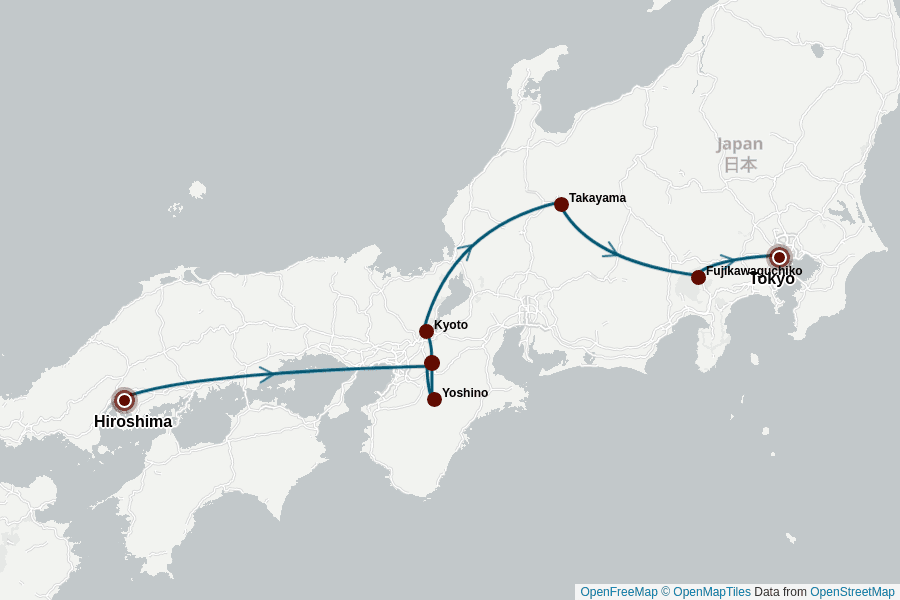
Altitude compresses the calendar. The Japanese Alps around Takayama and the Fuji lakes turn well before the temples of Kyoto, which are essentially at sea level. On a route that includes both, you can catch two stages of the same season a week apart.
What triggers it is cold nights, so a warm autumn delays everything and a sharp cold snap pulls it forward. Forecasts exist and are decent, but they move — and, as with blossom, no operator can promise you a peak.
%3Aformat(webp)%2Fa9ed18bb-3811-4c78-b1a5-702a25a826f5-de103_kv_ishigaki-island-scenery.webp&w=1920&q=75)
Five reasons we hear repeatedly from people who have now done both.
A longer window. Blossom lasts about a week in one place; maples hold for two to three, and the season across the country runs for two months.
More settled weather. Autumn is generally drier and clearer than spring, with less of the rain that can flatten a blossom trip.
Fewer people. Autumn is busy, particularly in Kyoto, but it is not the international scramble that late March and early April have become.
Better light. Low autumn sun through maples is what the photographs are made of.
Food. Autumn is the best eating season in Japan — mushrooms, chestnuts, persimmon, new rice, and the year's sake.
%3Aformat(webp)%2Fccab579d-5a3c-4f35-86e4-242d6a3a7080-takashi-miyazaki-4velvd-vdvg-unsplash.jpg&w=1920&q=75)
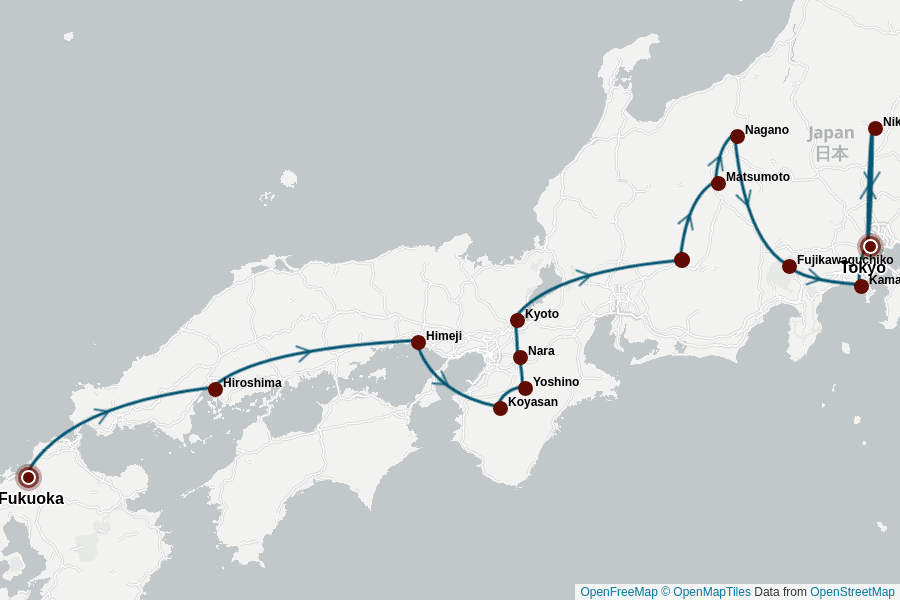
Japan Essentials — 14 days, Fukuoka to Tokyo. The route travels south to north, which in autumn means moving against the front — so the mountain sections around Takayama and the Fuji lakes are the ones to watch, and they turn earlier than the cities.
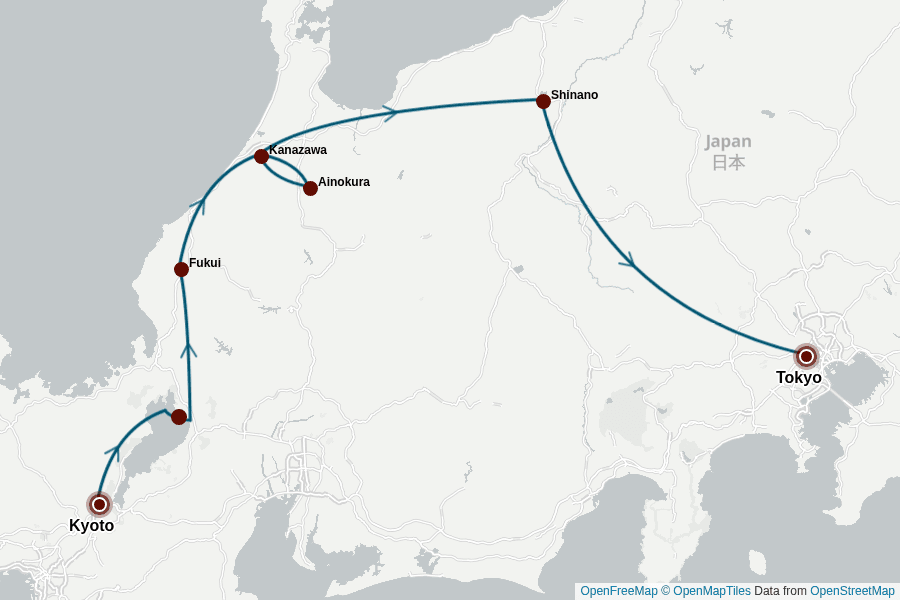
Japan Undiscovered — 12 days, starting in Kyoto and taking in Lake Biwa, the temples of Fukui, the Gassho-zukuri villages and the samurai quarter of Kanazawa. This is the quieter option in a busy season, and Kanazawa's gardens in autumn are exceptional.
Golden Route Plus — 20 days, which crosses enough of the country and enough altitude to catch several stages of the season.
Gardens, temple grounds and mountain valleys are where the colour is best — and in a small group of twelve you can be at a temple garden early, before the coaches.
%3Aformat(webp)%2Fhubspot_blogs%2F70794303268-3Apr11202210105536AM.png&w=1920&q=75)
Autumn departures fill early — not quite as ferociously as blossom, but early. A year ahead is normal for the dates people want, and long-haul flights on those dates are both scarcer and dearer.
Because every departure is guaranteed — it runs regardless of how many others have booked, from a single booking onwards — there is no waiting to see whether a trip will go ahead. Confirm the tour, then buy flights around the confirmed dates. More on that in how far ahead should you book.
All our Japan tours are land-only; we publish recommended routes and timings for each.
%3Aformat(webp)%2Fhubspot_blogs%2F6007207693-TokyoskylineinJapan2.jpeg&w=1920&q=75)
Autumn if you want a longer, more forgiving window, drier weather, better food and slightly fewer people — and if the image in your head is a maple over a temple pond.
Spring if cherry blossom is the reason you are going to Japan at all. In that case read when to see Japan's cherry blossom without the worst of the crowds, and book a year out.
Either if what you actually want is Japan. Our best time to visit Japan compares all four seasons, and two weeks in Japan sets out the route day by day.
And the honest note we give every traveller about both seasons: go for the country, and treat the colour as the bonus it is.
Select Date Range
Contact us
We’d love to hear from you. Please fill out this form.
All fields marked with (*) are mandatory.
%3Aformat(webp)%2Fhubspot_blogs%2F139498404980-shinkansen.png&w=1920&q=75)
%3Aformat(webp)%2Fpage_builder%2F6e550f51-fd59-473a-8ace-66609191408c-pexels-change-c-c-974768353-20802565.jpg&w=1920&q=75)
%3Aformat(webp)%2Fhubspot_blogs%2F75955362155-HoiAnNightMarket2.jpg&w=1920&q=75)

%3Aformat(webp)%2Ftravel_report_photo%2F82454%2F1801fc65-2b8a-463a-81ea-f3667803ca89-F3E0C42F-01A8-4E52-B4D9-DFD809199453.jpg&w=1920&q=75)
%3Aformat(webp)%2Fprofile-picture%2F5eefd57b-6c1b-49d0-8b90-eec430dbea31-dcc716ae-0681-47a9-8dee-8302ea7cbe02-c0cbebc6-a55d-4dd3-b824-4f1b72ae39b3.jpeg&w=1920&q=75)
%3Aformat(webp)%2Fhubspot_blogs%2F70794303268-3Apr11202210105536AM.png&w=1920&q=75)
%3Aformat(webp)%2Fimg%2F2048x1536%2F269723.jpg&w=1920&q=75)
%3Aformat(webp)%2Fprofile-picture%2F931d06cf-3d6a-42aa-956a-1ecce7079159-5fd74991-6c73-4f43-8298-6fda2d261d1d-7FA23F9B-A826-427F-8A4E-C1E2D3A01559.jpg&w=1920&q=75)
%3Aformat(webp)%2F6682e168-e97c-4a89-a861-88229f57d072-kanazawa-castle.jpg&w=1920&q=75)
%3Aformat(webp)%2Ftravel_report_photo%2F84516%2Fc540e5c8-bb92-40bc-8710-5554864e95b2-7AE4A5AA-176C-42E4-880D-83AA3A75EFCC.jpg&w=1920&q=75)
%3Aformat(webp)%2Fheader_media%2Fdd5149a2-07da-420b-a8ba-051a9f826b4a-img_5059.jpeg&w=1920&q=75)
%3Aformat(webp)%2Ftravel_report_photo%2F84408%2F43c5610c-0aeb-4714-ad75-e20153e92eb7-5C9B2829-6907-46DF-ACF2-B0403BD7A419.jpg&w=1920&q=75)
%3Aformat(webp)%2Fday_detail%2F4b2374e2-99e1-481c-9084-278276ff1302-antoine-cantoro-6y0u0wodxnw-unsplash.jpg&w=1920&q=75)
%3Aformat(webp)%2Ftravel_report_photo%2F83531%2F3b22254e-f14e-4b9a-9429-b562f2bf64a8-2F8501E7-DC9C-484F-AFAE-DE70E56B2949.jpg&w=1920&q=75)
%3Aformat(webp)%2Ftravel_report_photo%2F84499%2F682ade66-d4b2-419d-839b-d70480a55b9d-3d236001-6e39-4431-88d0-472c11e65cef.jpeg&w=1920&q=75)
%3Aformat(webp)%2F44e78e22-2282-4f09-a975-0d1f3fca21a9-timo-volz-dgsql2j028e-unsplash.jpg&w=1920&q=75)