%3Aformat(webp)%2Fpage_builder%2F6e550f51-fd59-473a-8ace-66609191408c-pexels-change-c-c-974768353-20802565.jpg&w=1920&q=75)
For a good number of our travellers, the food turns out to be the reason to come back — and almost none of them expected that before they went.
Japanese food in Britain means sushi, ramen and perhaps katsu. In Japan it means a different dish in every region, a seasonal calendar taken seriously, and a standard of ordinary everyday eating that has no real equivalent anywhere.
In short
The route doubles as a food journey, which is not an accident.
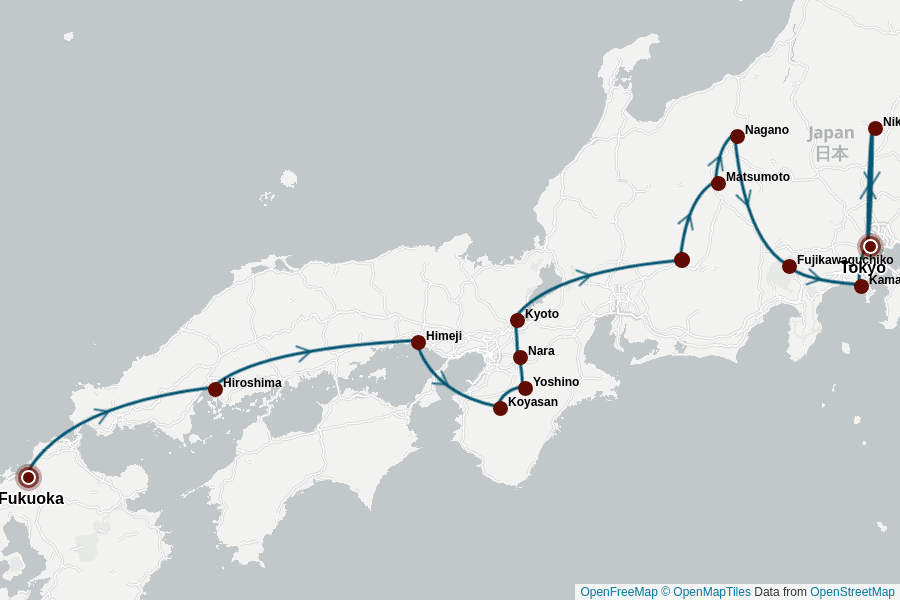
Fukuoka, where the trip begins, is a ramen city — the tonkotsu pork-bone broth that most British ramen shops are imitating started here, and the street food stalls along the river are an institution.
Hiroshima does okonomiyaki its own way, layered rather than mixed, with noodles inside — and the local rivalry with Osaka over the correct method is taken entirely seriously.
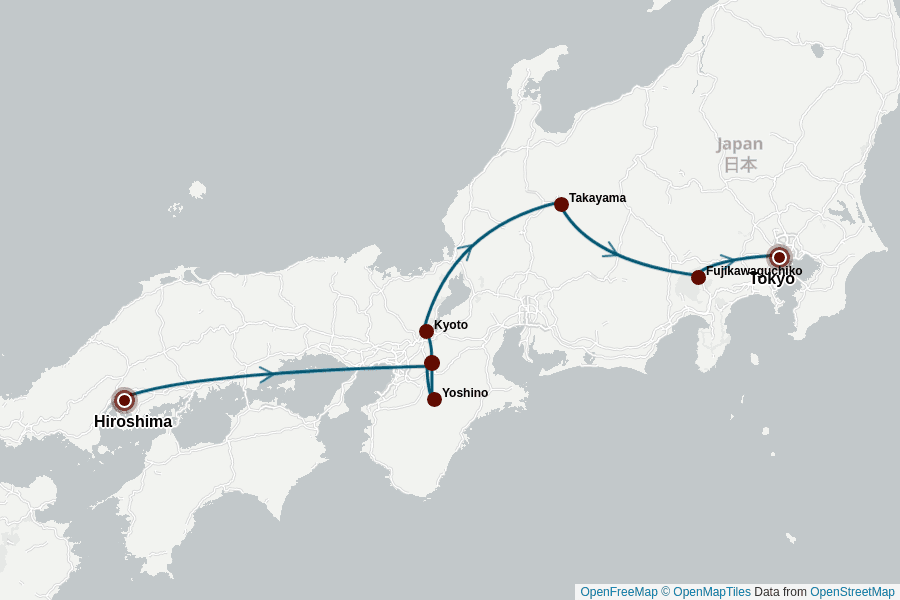
Kyoto is the refined end: kaiseki, tofu that will change your mind about tofu, matcha in the town that made it famous, and wagashi sweets designed around the season.
Takayama, in the mountains, means Hida beef, miso and sake — the town has several breweries within a few streets.
Tokyo is everything at once, from a department-store food hall to a six-seat counter in an alley.
That progression is one of the quiet arguments for travelling south to north rather than flying into Tokyo and out again.
%3Aformat(webp)%2Fa9ed18bb-3811-4c78-b1a5-702a25a826f5-de103_kv_ishigaki-island-scenery.webp&w=1920&q=75)
Breakfast every day. In Japan this is worth taking seriously — a traditional breakfast of rice, fish, miso and pickles is not what a British traveller expects at seven in the morning, and converts more people than any other meal.
A cooking class in Kyoto, where you make it rather than watch it.
A night with a host family, which is where most travellers meet home cooking rather than the restaurant version — and which is consistently the thing they talk about most afterwards.
Further meals as the itinerary specifies — the trip page lists exactly which. Drinks are not included, and alcohol never is.
Free evenings, deliberately. In Japan the freedom to wander into somewhere with no English menu and point at what looks good is a genuine pleasure, and your tour leader will point you at the places they eat themselves.
%3Aformat(webp)%2Fccab579d-5a3c-4f35-86e4-242d6a3a7080-takashi-miyazaki-4velvd-vdvg-unsplash.jpg&w=1920&q=75)
This comes up often, and the honest answer is reassuring.
There is far more familiar food than people expect: grilled meat and fish, rice, noodles, tempura, breaded cutlets, curry. Raw fish is available everywhere and compulsory nowhere.
What is genuinely harder is strict vegetarian and vegan eating, because dashi — a stock made with fish flakes — is in a great deal of everyday cooking, including things that look plainly vegetable. It is manageable, and it is much more manageable if we know at booking rather than on arrival.
Allergies likewise: tell your specialist at the time of booking so it can be communicated properly in Japanese ahead of the meals that are included.
And one small practical thing that matters more than it sounds: chopsticks are the norm, forks are usually available if you ask, and nobody minds in the slightest.
%3Aformat(webp)%2Fhubspot_blogs%2F70794303268-3Apr11202210105536AM.png&w=1920&q=75)
Not a test, and Japanese hosts are famously forgiving of visitors. But a few things make you a better guest.
Do not stick chopsticks upright in rice — it echoes a funeral rite. Rest them on the holder.
Slurping noodles is fine, and in some places expected.
Tipping is not customary and can cause confusion. Good service is simply the standard.
Say itadakimasu before eating and gochisousama afterwards. Two words, and they land warmly every time.
Eating while walking is generally avoided outside festival streets and market stalls.
Your guide will steer you through the rest as it comes up — which is a good deal easier than reading a list before you go.
%3Aformat(webp)%2Fhubspot_blogs%2F6007207693-TokyoskylineinJapan2.jpeg&w=1920&q=75)
Japan Essentials — 14 days, Fukuoka to Tokyo, with the cooking class in Kyoto and the host-family night. The fullest food journey of our routes, simply because it crosses the most regions. Our two weeks in Japan itinerary sets it out day by day.
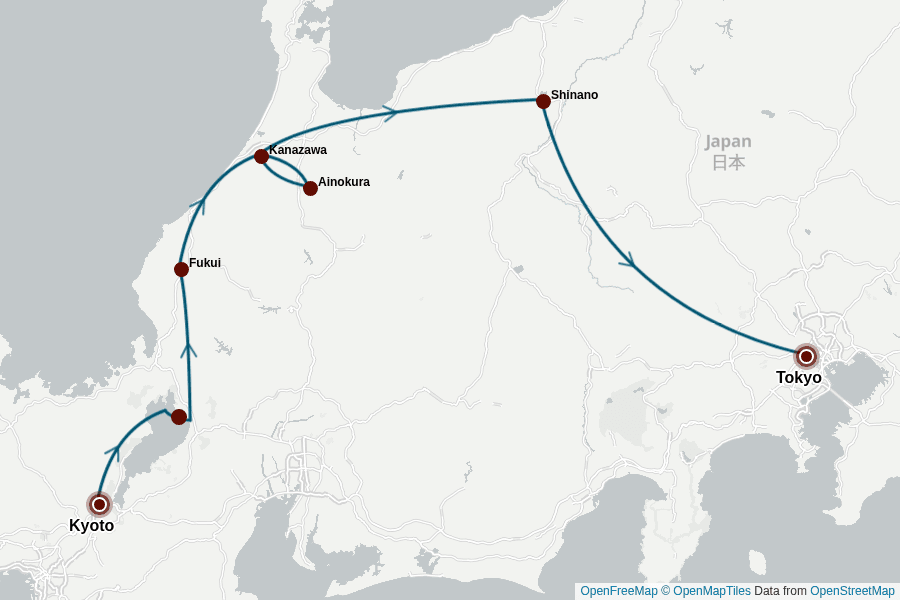
Japan Undiscovered — 12 days, starting in Kyoto, with a rural host-family night in Shinano and quieter regional eating around Kanazawa and Fukui.
Golden Route Plus — 20 days, which adds a sushi-making day in Kyoto among much else.
All carry a maximum of 12 travellers, are land-only, and run on guaranteed departures — they go ahead regardless of how many others have booked.
If food is the main reason you are going, say so when you enquire. It changes which departure a specialist suggests — autumn in particular is the best eating season in Japan.
Select Date Range
Contact us
We’d love to hear from you. Please fill out this form.
All fields marked with (*) are mandatory.
%3Aformat(webp)%2Fhubspot_blogs%2F139498404980-shinkansen.png&w=1920&q=75)
%3Aformat(webp)%2Fhubspot_blogs%2F99879522350-HerbstJapan.png&w=1920&q=75)
%3Aformat(webp)%2Fhubspot_blogs%2F75955362155-HoiAnNightMarket2.jpg&w=1920&q=75)

%3Aformat(webp)%2Ftravel_report_photo%2F82454%2F1801fc65-2b8a-463a-81ea-f3667803ca89-F3E0C42F-01A8-4E52-B4D9-DFD809199453.jpg&w=1920&q=75)
%3Aformat(webp)%2Fprofile-picture%2F5eefd57b-6c1b-49d0-8b90-eec430dbea31-dcc716ae-0681-47a9-8dee-8302ea7cbe02-c0cbebc6-a55d-4dd3-b824-4f1b72ae39b3.jpeg&w=1920&q=75)
%3Aformat(webp)%2Fhubspot_blogs%2F70794303268-3Apr11202210105536AM.png&w=1920&q=75)
%3Aformat(webp)%2Fimg%2F2048x1536%2F269723.jpg&w=1920&q=75)
%3Aformat(webp)%2Fprofile-picture%2F931d06cf-3d6a-42aa-956a-1ecce7079159-5fd74991-6c73-4f43-8298-6fda2d261d1d-7FA23F9B-A826-427F-8A4E-C1E2D3A01559.jpg&w=1920&q=75)
%3Aformat(webp)%2F6682e168-e97c-4a89-a861-88229f57d072-kanazawa-castle.jpg&w=1920&q=75)
%3Aformat(webp)%2Ftravel_report_photo%2F84516%2Fc540e5c8-bb92-40bc-8710-5554864e95b2-7AE4A5AA-176C-42E4-880D-83AA3A75EFCC.jpg&w=1920&q=75)
%3Aformat(webp)%2Fheader_media%2Fdd5149a2-07da-420b-a8ba-051a9f826b4a-img_5059.jpeg&w=1920&q=75)
%3Aformat(webp)%2Ftravel_report_photo%2F84408%2F43c5610c-0aeb-4714-ad75-e20153e92eb7-5C9B2829-6907-46DF-ACF2-B0403BD7A419.jpg&w=1920&q=75)
%3Aformat(webp)%2Fday_detail%2F4b2374e2-99e1-481c-9084-278276ff1302-antoine-cantoro-6y0u0wodxnw-unsplash.jpg&w=1920&q=75)
%3Aformat(webp)%2Ftravel_report_photo%2F83531%2F3b22254e-f14e-4b9a-9429-b562f2bf64a8-2F8501E7-DC9C-484F-AFAE-DE70E56B2949.jpg&w=1920&q=75)
%3Aformat(webp)%2Ftravel_report_photo%2F84499%2F682ade66-d4b2-419d-839b-d70480a55b9d-3d236001-6e39-4431-88d0-472c11e65cef.jpeg&w=1920&q=75)
%3Aformat(webp)%2F44e78e22-2282-4f09-a975-0d1f3fca21a9-timo-volz-dgsql2j028e-unsplash.jpg&w=1920&q=75)