%3Aformat(webp)%2Fprovider%2Ffb1a1eb5-5141-480b-9877-a791074fbd43-kimono.jpeg&w=1920&q=75)
A fortnight is the right length for a first trip to Japan. It is long enough to travel from the southern island of Kyushu up to Tokyo, taking in Hiroshima, Kyoto, the Japanese Alps and Mount Fuji, without spending your holiday packing and unpacking. Any shorter and something important gets cut; much longer and you are into a second trip's worth of country.
The most common first-timer's mistake is to start in Tokyo. Landing in the largest city on earth, jet-lagged, is a rough introduction. We do it the other way round.
In short
Nearly every off-the-shelf Japan itinerary begins in Tokyo, because that is where the flights are cheapest. It is not where a first trip is best begun.
Our route lands you in Fukuoka, a manageable city on the southern island of Kyushu with a small, calm airport. You find your feet in a place where the scale is human, then work north through Hiroshima, Nara and Kyoto, arriving in Tokyo at the very end — by which point you can read a station sign, use a train, and enjoy the noise rather than be flattened by it.
It also means the country unfolds chronologically. You meet old Japan first: temples, shrines, a countryside homestay, an imperial capital. Tokyo then lands as the astonishing contrast it actually is, rather than as the baffling opening chapter.
%3Aformat(webp)%2Fa9ed18bb-3811-4c78-b1a5-702a25a826f5-de103_kv_ishigaki-island-scenery.webp&w=1920&q=75)
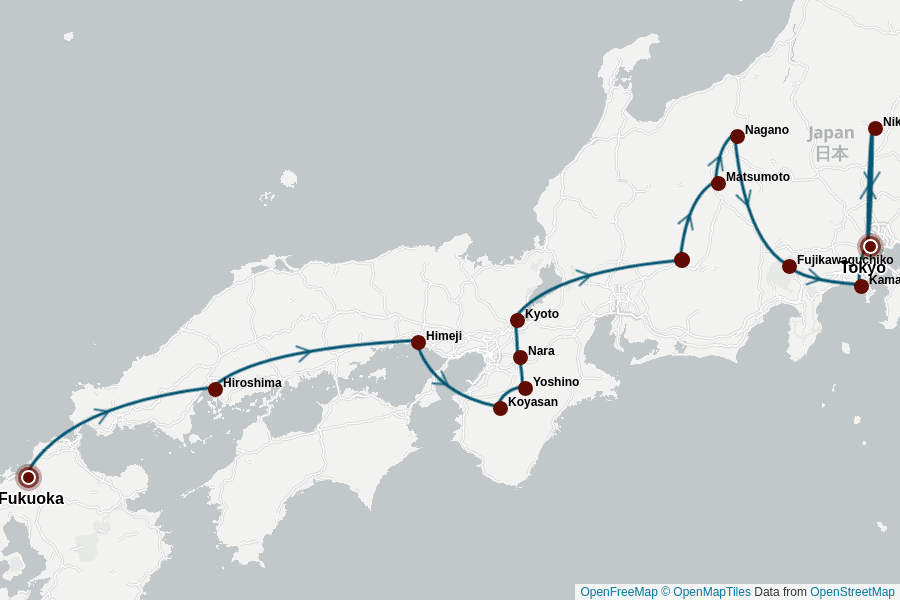
Day 1 — Fukuoka. Arrival, met at the airport, and a gentle first evening.
Days 2–3 — Hiroshima and Miyajima. The Shinkansen east to Hiroshima, the Peace Park and the Atomic Bomb Dome, then the sacred island of Miyajima and its floating torii gate.
Day 4 — Nara. Japan's first capital, its great temples and its Buddhist monks.
Day 5 — the countryside. A night with a Japanese host family, which is regularly the thing travellers talk about most afterwards.
Days 6–9 — Kyoto. Four days, and worth every one: the temples and the old streets, a cooking class, the Arashiyama bamboo grove, and the torii tunnels of Fushimi Inari.
Day 10 — Takayama. North into the Japanese Alps and a beautifully preserved old town.
Day 11 — Mount Fuji. Lake Kawaguchi, and a thirty-minute walk up to the Koyodai Observatory for the view — weather permitting, which is part of the deal with Fuji.
Days 12–13 — Tokyo. The city at last: its oldest temple, its neighbourhoods, and enough time to find your own corner of it.
Day 14 — home.
%3Aformat(webp)%2Fccab579d-5a3c-4f35-86e4-242d6a3a7080-takashi-miyazaki-4velvd-vdvg-unsplash.jpg&w=1920&q=75)
Being straight about this saves disappointment later.
Two weeks does not stretch to Hokkaido in the far north, to the subtropical islands of Okinawa, or to the full length of the Nakasendo post road. It does not include a long stay at a ski resort or a serious mountain hike. And while you will see Mount Fuji, you will not climb it.
There is also the weather. Fuji hides behind cloud for a good part of the year, and June and July are properly wet. Neither is a reason not to go — but a fortnight is a fortnight, and Japan is a country most of our travellers come back to.
If you would rather do it all in one go, our twenty-day Golden Route Plus adds Koyasan, Himeji, the Nakasendo trail, Matsumoto, Nagano, Kamakura and Nikko.
%3Aformat(webp)%2Fhubspot_blogs%2F70794303268-3Apr11202210105536AM.png&w=1920&q=75)
Cities are connected by Shinkansen rather than by coach, so the transitions are short and comfortable and you arrive in city centres. Your main suitcase is couriered ahead twice — from Hiroshima to Kyoto, and from Kyoto to Tokyo — so you travel the middle stretch with just an overnight bag.
Within each place you explore on foot, which in Japan means several hours on your feet across a day and a fair number of steps at temples and stations. We have written honestly about that in how much walking is there on a Japan tour.
Groups are capped at 12 travellers, with an English-speaking guide throughout.
%3Aformat(webp)%2Fhubspot_blogs%2F6007207693-TokyoskylineinJapan2.jpeg&w=1920&q=75)
Spring and autumn are the classic windows, and both are busy for good reason; our guide to the best time to visit Japan sets out the trade-offs season by season.
Japan Essentials runs the fourteen-day route above. It is land-only, so you book the international flights that suit you; we publish recommended routes and timings for our Japan tours. It runs on guaranteed departures, meaning it goes ahead regardless of how many others have booked.
Cherry blossom and autumn colour dates fill first, often a year ahead. If either matters to you, that is the conversation to have with a Japan specialist sooner rather than later.
Select Date Range
Contact us
We’d love to hear from you. Please fill out this form.
All fields marked with (*) are mandatory.
%3Aformat(webp)%2Fprovider%2Ffb1a1eb5-5141-480b-9877-a791074fbd43-kimono.jpeg&w=1920&q=75)
%3Aformat(webp)%2Fprovider%2Ff45dc6a1-8dfd-421b-9aab-ee99b3d68b9b-1mc6912000k5zec4v0ce8_w_1280_853_r5.webp&w=1920&q=75)

%3Aformat(webp)%2Ftravel_report_photo%2F82454%2F1801fc65-2b8a-463a-81ea-f3667803ca89-F3E0C42F-01A8-4E52-B4D9-DFD809199453.jpg&w=1920&q=75)
%3Aformat(webp)%2Fprofile-picture%2F5eefd57b-6c1b-49d0-8b90-eec430dbea31-dcc716ae-0681-47a9-8dee-8302ea7cbe02-c0cbebc6-a55d-4dd3-b824-4f1b72ae39b3.jpeg&w=1920&q=75)
%3Aformat(webp)%2Fhubspot_blogs%2F70794303268-3Apr11202210105536AM.png&w=1920&q=75)
%3Aformat(webp)%2Fimg%2F2048x1536%2F269723.jpg&w=1920&q=75)
%3Aformat(webp)%2Fprofile-picture%2F931d06cf-3d6a-42aa-956a-1ecce7079159-5fd74991-6c73-4f43-8298-6fda2d261d1d-7FA23F9B-A826-427F-8A4E-C1E2D3A01559.jpg&w=1920&q=75)
%3Aformat(webp)%2F6682e168-e97c-4a89-a861-88229f57d072-kanazawa-castle.jpg&w=1920&q=75)
%3Aformat(webp)%2Ftravel_report_photo%2F84516%2Fc540e5c8-bb92-40bc-8710-5554864e95b2-7AE4A5AA-176C-42E4-880D-83AA3A75EFCC.jpg&w=1920&q=75)
%3Aformat(webp)%2Fheader_media%2Fdd5149a2-07da-420b-a8ba-051a9f826b4a-img_5059.jpeg&w=1920&q=75)
%3Aformat(webp)%2Ftravel_report_photo%2F84408%2F43c5610c-0aeb-4714-ad75-e20153e92eb7-5C9B2829-6907-46DF-ACF2-B0403BD7A419.jpg&w=1920&q=75)
%3Aformat(webp)%2Fday_detail%2F4b2374e2-99e1-481c-9084-278276ff1302-antoine-cantoro-6y0u0wodxnw-unsplash.jpg&w=1920&q=75)
%3Aformat(webp)%2Ftravel_report_photo%2F83531%2F3b22254e-f14e-4b9a-9429-b562f2bf64a8-2F8501E7-DC9C-484F-AFAE-DE70E56B2949.jpg&w=1920&q=75)
%3Aformat(webp)%2Ftravel_report_photo%2F84499%2F682ade66-d4b2-419d-839b-d70480a55b9d-3d236001-6e39-4431-88d0-472c11e65cef.jpeg&w=1920&q=75)
%3Aformat(webp)%2F44e78e22-2282-4f09-a975-0d1f3fca21a9-timo-volz-dgsql2j028e-unsplash.jpg&w=1920&q=75)