%3Aformat(webp)%2Fheader_media%2Fbf350ea2-ea58-470f-a146-997785e3a26e-pexels-dsd-143941-1822605.jpg&w=1920&q=75)
Japan is unusually easy to travel alone and unusually hard to travel alone well.
It is safe, orderly and superbly connected. It is also a country where the language barrier is real, where a great deal happens behind doors you would not think to open, and where solo travellers routinely report going a week without a proper conversation.
A small group solves the second problem without reintroducing the first.
In short
More here than in most countries, and for a specific reason: Japan rewards being let in.
A great deal of what makes the country extraordinary happens in places that are not obvious, are not in English, and are not open to someone who walks in cold. A cooking class in Kyoto, an evening with a host family in the countryside, a conversation with monks at Nara — these are the days travellers remember, and they are the ones that are hardest to arrange for one.
The practical side matters too. Japanese rail is superb and genuinely bewildering the first time: reserved and unreserved carriages, station exits that are a fifteen-minute walk apart, and luggage rules on the shinkansen. A guide removes all of that.
And there is the plain fact that meals in Japan are better shared. Izakaya food is designed for a table.
%3Aformat(webp)%2Fhighlight%2F49d9c881-a2db-427e-956e-08bab525aae3-14809814300_bec2645434_o.jpg&w=1920&q=75)
The honest answer, first: travelling alone in Japan costs more than travelling as a couple, on our trips as on anyone's, because hotel rooms are priced by the room.
You are not asked to share. Some operators pair solo travellers with a stranger of the same sex to avoid the supplement. We do not do that. If you are travelling on your own you have your own room.
The single-room supplement varies by trip and by departure, so we will not print a figure that goes out of date — it is shown on the trip page and your specialist will confirm it. Our page on single supplements explained sets out how they work and why they exist.
One Japan-specific note: rooms in Japanese city hotels are small by British standards. That is true whoever you are travelling with, and worth knowing before you arrive.
%3Aformat(webp)%2Fhubspot_blogs%2F7494540430-270426.jpg&w=1920&q=75)
A fair question, and one solo travellers ask more than anyone else — because the fear is a fortnight with no time to yourself.
Our routes are built with real free time rather than token gaps. The twelve-day Kyoto-to-Tokyo route includes a free day in Tokyo, with an optional excursion to Hakone for those who want it. The fourteen-day route gives you four days based in Kyoto, which is enough to wander on your own between the group's plans. Both include free mornings and unstructured evenings.
The three-week route has the most of all, simply because it is longer, and it adds the Nakasendo walk between Magome and Tsumago — two and a half to three hours at your own pace.
What you do not have to organise is the moving: trains, transfers and luggage are handled.
%3Aformat(webp)%2Fimg%2F2048x1536%2F302839.jpg&w=1920&q=75)
The group is small — a maximum of 12 — and mixed. Couples, friends travelling in pairs, and solo travellers, mostly British, and mostly older than the backpacker crowd Japan is known for.
We are not going to invent a demographic breakdown for you. What we can say is that solo travellers are a normal part of every departure rather than an exception, and that at twelve people there is no back of the bus to be stuck at.
If being sociable is itself the worry rather than the appeal, read solo travel over 60, which is candid about how much joining-in is actually expected. The short version: less than people fear.
%3Aformat(webp)%2Fheader_media%2Fd3eb0a0f-f33d-4411-9525-314bac547e2d-costa-rica-14-1-.jpg&w=1920&q=75)
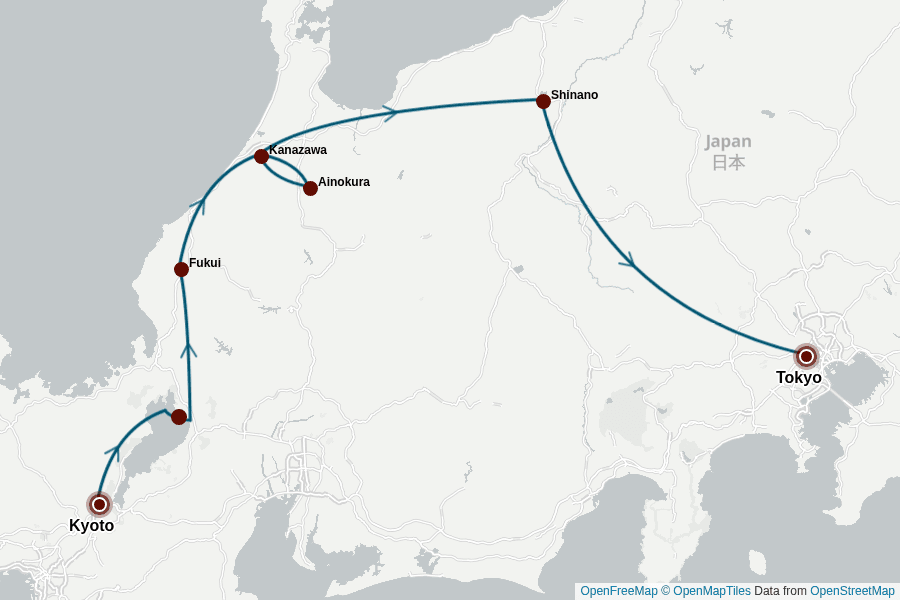
Twelve days, Kyoto to Tokyo. The gentlest introduction, and the one with the most free time in proportion to its length. Kyoto, Lake Biwa, the temples of Fukui, Kanazawa, the Ainokura villages, a host-family night in Shinano and Tokyo. See is 12 days enough for Japan.
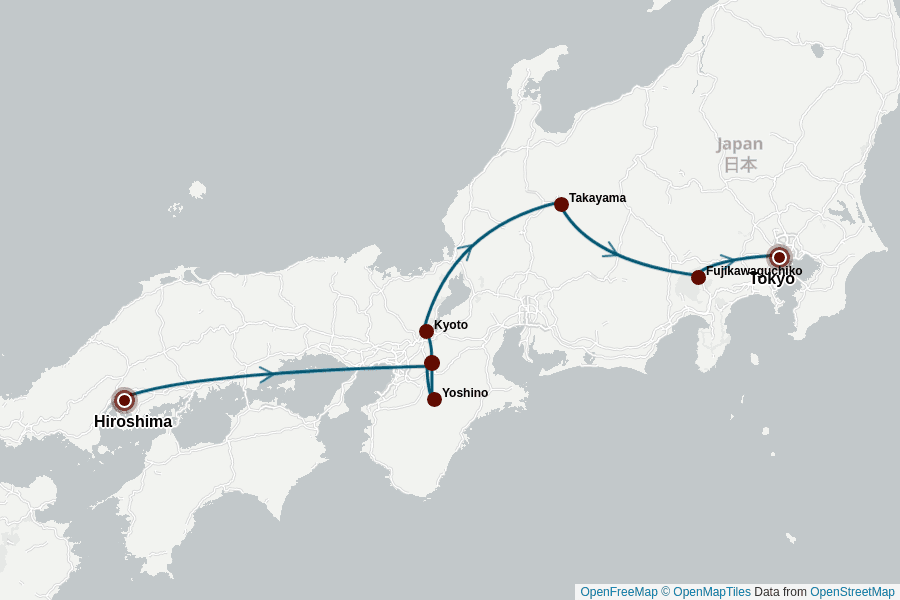
Fourteen days, Fukuoka to Tokyo. The fuller first-timer's route: Hiroshima, Miyajima, Nara, a countryside host family, four days in Kyoto, Takayama, Mount Fuji and Tokyo. See two weeks in Japan.
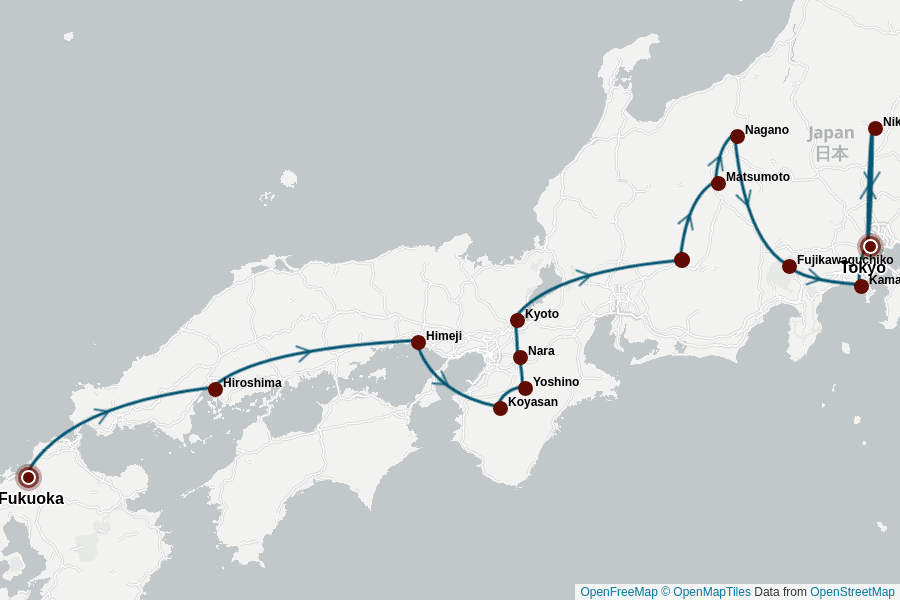
Twenty days. For travellers who have been before or who want Koyasan, Yoshino, the Nakasendo, Matsumoto, Nagano and Nikko as well.
All are land-only, so you book the flights that suit you, all take a maximum of 12, and all run on guaranteed departures. Our guide to how much walking there is on a Japan tour covers the physical side.
Select Date Range
Contact us
We’d love to hear from you. Please fill out this form.
All fields marked with (*) are mandatory.
%3Aformat(webp)%2Fhubspot_blogs%2F7494540430-270426.jpg&w=1920&q=75)
%3Aformat(webp)%2Fhighlight%2F49d9c881-a2db-427e-956e-08bab525aae3-14809814300_bec2645434_o.jpg&w=1920&q=75)
%3Aformat(webp)%2Fday_detail%2F40883ef3-9a75-4a2a-b9ca-d7170f1c0875-whatsapp-image-2025-07-16-at-08.30.39.jpeg&w=1920&q=75)

%3Aformat(webp)%2Ftravel_report_photo%2F82454%2F1801fc65-2b8a-463a-81ea-f3667803ca89-F3E0C42F-01A8-4E52-B4D9-DFD809199453.jpg&w=1920&q=75)
%3Aformat(webp)%2Fprofile-picture%2F5eefd57b-6c1b-49d0-8b90-eec430dbea31-dcc716ae-0681-47a9-8dee-8302ea7cbe02-c0cbebc6-a55d-4dd3-b824-4f1b72ae39b3.jpeg&w=1920&q=75)
%3Aformat(webp)%2Fhubspot_blogs%2F70794303268-3Apr11202210105536AM.png&w=1920&q=75)
%3Aformat(webp)%2Fimg%2F2048x1536%2F269723.jpg&w=1920&q=75)
%3Aformat(webp)%2Fprofile-picture%2F931d06cf-3d6a-42aa-956a-1ecce7079159-5fd74991-6c73-4f43-8298-6fda2d261d1d-7FA23F9B-A826-427F-8A4E-C1E2D3A01559.jpg&w=1920&q=75)
%3Aformat(webp)%2F6682e168-e97c-4a89-a861-88229f57d072-kanazawa-castle.jpg&w=1920&q=75)
%3Aformat(webp)%2Ftravel_report_photo%2F84516%2Fc540e5c8-bb92-40bc-8710-5554864e95b2-7AE4A5AA-176C-42E4-880D-83AA3A75EFCC.jpg&w=1920&q=75)
%3Aformat(webp)%2F94126af0-449f-4709-b69c-64f044c3f720-img_3021.jpg&w=1920&q=75)
%3Aformat(webp)%2Ftravel_report_photo%2F84408%2F43c5610c-0aeb-4714-ad75-e20153e92eb7-5C9B2829-6907-46DF-ACF2-B0403BD7A419.jpg&w=1920&q=75)
%3Aformat(webp)%2Fday_detail%2F4b2374e2-99e1-481c-9084-278276ff1302-antoine-cantoro-6y0u0wodxnw-unsplash.jpg&w=1920&q=75)
%3Aformat(webp)%2Ftravel_report_photo%2F83531%2F3b22254e-f14e-4b9a-9429-b562f2bf64a8-2F8501E7-DC9C-484F-AFAE-DE70E56B2949.jpg&w=1920&q=75)
%3Aformat(webp)%2Ftravel_report_photo%2F84499%2F682ade66-d4b2-419d-839b-d70480a55b9d-3d236001-6e39-4431-88d0-472c11e65cef.jpeg&w=1920&q=75)
%3Aformat(webp)%2F44e78e22-2282-4f09-a975-0d1f3fca21a9-timo-volz-dgsql2j028e-unsplash.jpg&w=1920&q=75)