%3Aformat(webp)%2Fimg%2F2048x1536%2F296918.jpg&w=1920&q=75)
Toshogu Shrine, the shogun's mausoleum
One of the most famous shrines in Japan
Information about Nikko Toshogu Shrine, the shogun's mausoleum
During your trip to Japan, we strongly recommend that you spend a day or two in Nikko. Tucked away in the city's natural surroundings, you will find one of Japan's most famous shrines, the Toshogu Shrine Complex, dedicated to the shogun (army chief) Tokugawa Ieyasu, founder of the Tokuwaga shogunate, a family and dynasty that ruled Japan from the 16th to the mid-19th century.
It is one of the greatest constructions in Japan: the best craftsmen had the heavy task of building the most beautiful shrine ever seen in Japan. And as nothing is too beautiful for the shogun, the budget for the construction was unlimited. Among all these buildings, 8 are classified as national treasures and 34 are important cultural properties.
The complex consists of three adjacent sites located in the cedar forest on the slopes of the mountain: a Buddhist temple Rinno-ji and two Shinto shrines, Futurasan and Toshogu.
Interesting facts about Nikko Toshogu Shrine, the shogun's mausoleum
The shogun Tokugawa Ieyasu is buried there. Initially a relatively simple mausoleum, Ieyasu's grandson, Iemitsu, undertook work to enlarge it to the spectacular complex it is today.
One of the most famous is that of the three monkeys who, according to Buddhist teachings, cover their ears, eyes and mouth. They have become so popular that they are now found on almost all emoji keyboards. 🙊🙈🙉
You may notice that Toshogu contains both Shinto and Buddhist elements. It was common for places of worship to contain elements of both religions until the Meiji period, when Shintoism was deliberately separated from Buddhism.
The site of Nikko is a UNESCO World Heritage Site.
Pictures of Nikko Toshogu Shrine, the shogun's mausoleum
%3Aformat(webp)%2Fimg%2F2048x1536%2F296918.jpg&w=1920&q=75)
%3Aformat(webp)%2Fimg%2F2048x1536%2F296916.jpg&w=1920&q=75)
+3
%3Aformat(webp)%2Fimg%2F2048x1536%2F296917.jpg&w=1920&q=75)
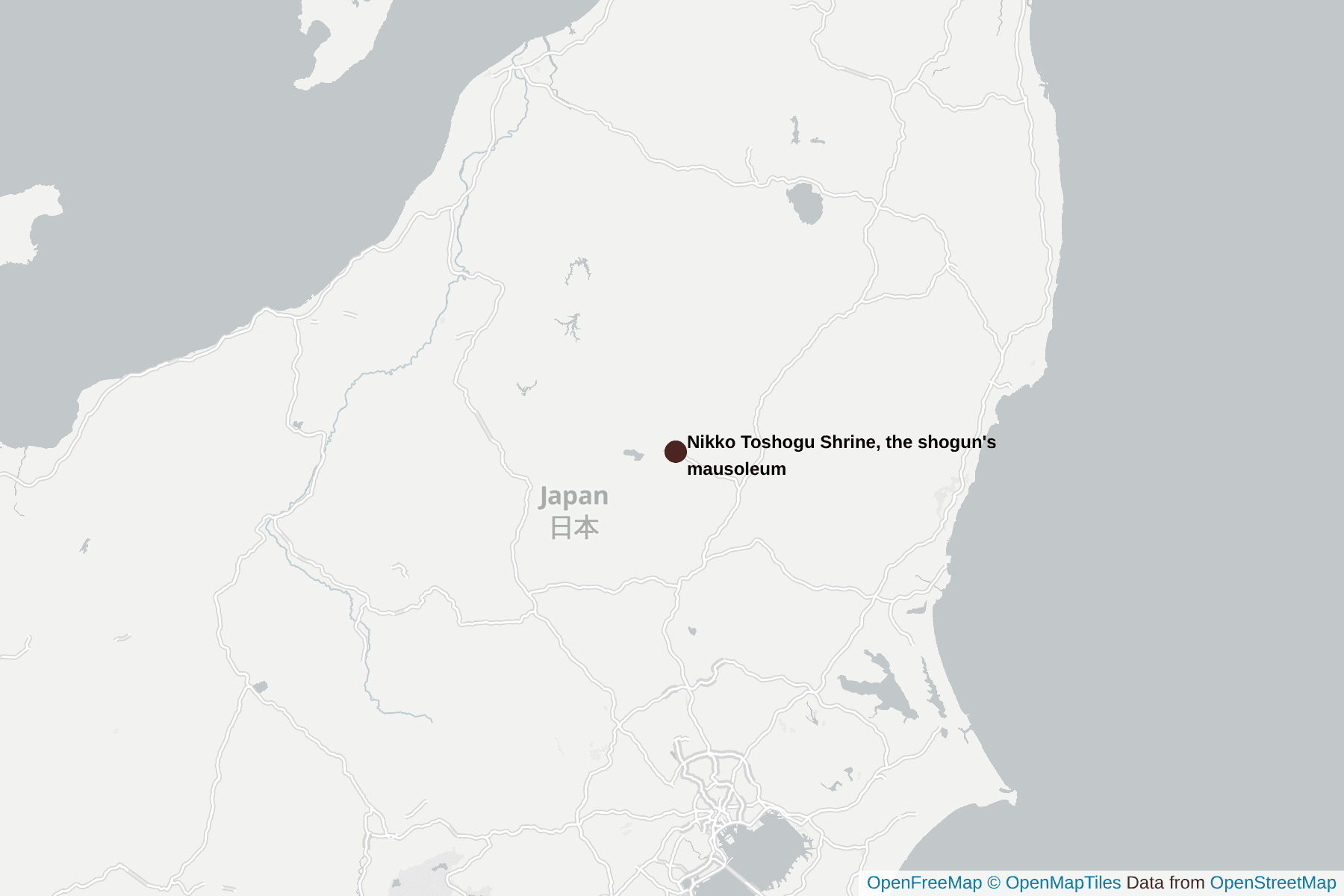
Wo ist Nikko Toshogu Shrine, the shogun's mausoleum?
%3Aformat(webp)%2Fday_detail%2Fddf30ee3-a607-4188-8760-244ce4ddbd2a-46140552042_d36f30f65e_b.jpg&w=1920&q=75)
%3Aformat(webp)%2Fimg%2F2048x1536%2F296905.jpg&w=1920&q=75)
%3Aformat(webp)%2F7bf2c8ce-c227-46e4-802f-e289b0d25cf1-pexels-tris-truong-792420816-19146696.jpg&w=1920&q=75)