It is pretty common to find deers in public parks in Japan. Most of it is due to the fact that they are considered a sacred animal because of their significance in Shintoism, one of the two main religions of Japan.
The most significant place for the deers in Japan is the very well known Nara park, where as many as 1200 deers roam free and live a very wealthy life, protected by the law and spoiled by the tourists. In fact, in exchange for a pose for a selfie, tourist from all over the world visting Nara are more than happy to feed these curious animals with bread or sweets.
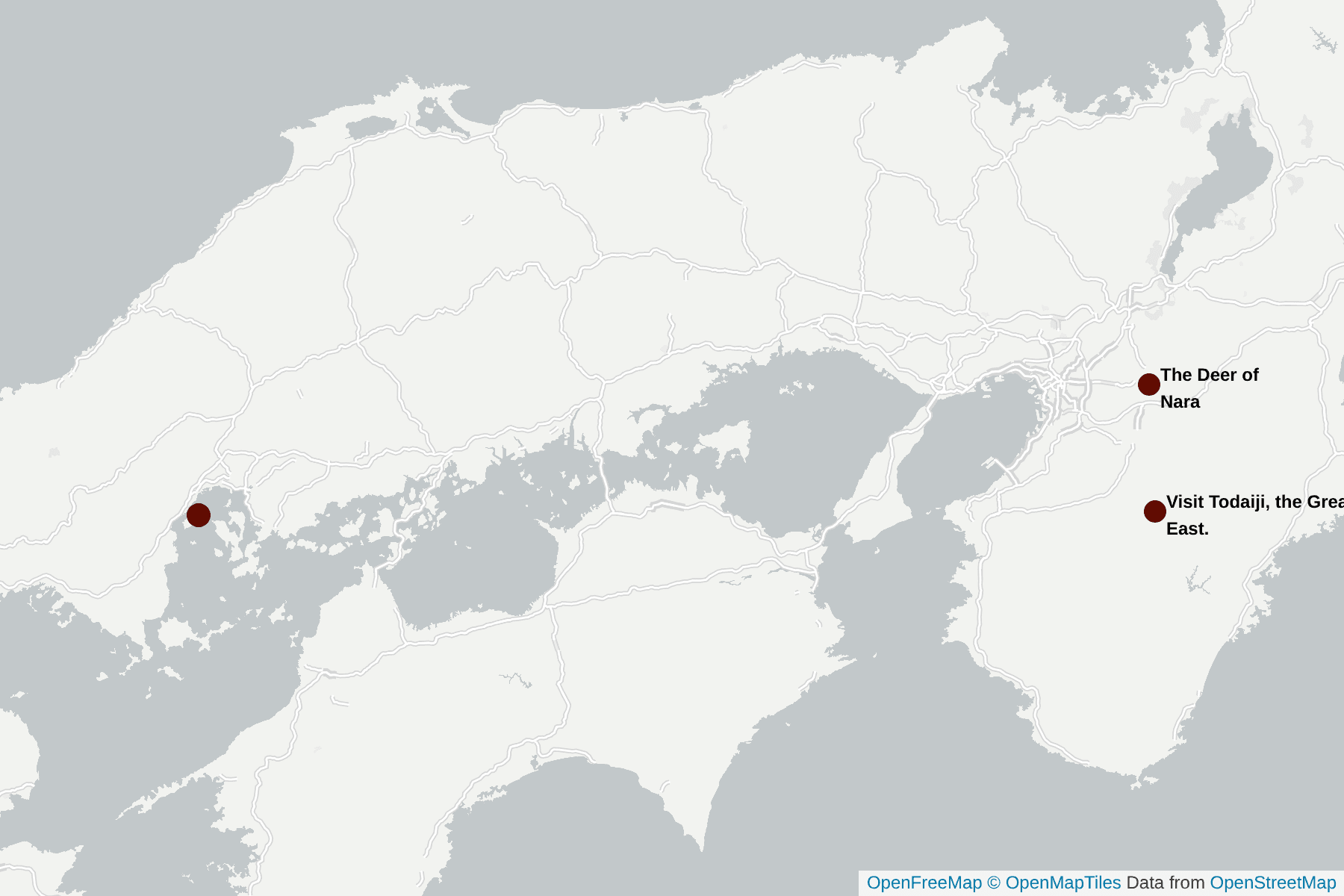
When you visit Japan, we recommend you to take some time to familiarize with the deers, bring some snacks to feed them and take the unmissable souvenir photo, either in Nara park or on the Miajima island, both areas where the Japanese deers reign and entertain the tourists.
Deers will eat literally whatever you feed them. Both in Miyajima and in Nara Park, the two most famous places for deers spotting in Japan, you will be "assaulted" by the curious and constantly-hungry animal. They will accept from you sweets, candies, a sandwich or the regular food that you can buy at the designated stands that sell you the specific food for them. Be careful with them! They are so hungry, they will come close to your backpack and sniff if there is anything to eat! It is not uncommon to see them eating paper maps from the hands of the astonished and shocked visitors!
There are more than 50 types of deers in the world, but the ones we meet in Japan can only be found here. The scientific name is "cervus nippon" and this says a lot about their connection with Japan ("Nippon" in Japanese). This species is here overabundant and easy to be found around.
Nara deers are said to be able to bow at visitors. For the amusement of the passersby, when they approach a deer, the animal can be seen lowering its head as it was bowing, which is a very common social habit in Japan. Unlike the Japanese humans however, the deeers don't bow out of politeness, but they are all about food! In fact they do this, because they have learned in time that like this they can more easily conquer the hearts of the visitors, whose hands are full of sweets they can't wait to get!
%3Aformat(webp)%2Fday_detail%2F6a67295f-7cb0-4665-8be6-73e941b789fb-deer-nara-.jpg&w=1920&q=75)
%3Aformat(webp)%2Fimg%2F2048x1536%2F312402.jpg&w=1920&q=75)
%3Aformat(webp)%2Fimg%2F2048x1536%2F293073.jpg&w=1920&q=75)
%3Aformat(webp)%2Fday_detail%2Fa1e2bf24-c903-460f-b510-7029ecca2288-sp_main.jpg&w=1920&q=75)
%3Aformat(webp)%2Fimg%2F2048x1536%2F312402.jpg&w=1920&q=75)
%3Aformat(webp)%2Fday_detail%2F7e5745bc-7d2e-4625-862b-d7e1b9646101-itsukushima-miyajima-.jpg&w=1920&q=75)
%3Aformat(webp)%2Fday_detail%2F098514d2-b9e2-4c15-b408-f6d79149b9b8-todaiji-nara-.jpg&w=1920&q=75)